
DRAGONFLY JOURNAL
Exclusive Retreats Beat Apartments for Group Stays in Málaga
Exclusive Retreats Beat Apartments for Group Stays in Málaga

For a private group stay, an exclusive-use venue such as a countryside retreat usually beats a scattered mix of hotel rooms or city apartments. It keeps everyone together, gives you shared spaces to cook, eat and relax in, and avoids the noise restrictions that increasingly apply to short-term rentals inside Málaga itself. The checklist below shows exactly what to confirm before you book.
TL;DR:
- Countryside retreat venues near Coín or Mijas often offer exclusive use, outdoor spaces, and curated activities ideal for group privacy and bonding.
- Confirm that the property has enough staff, amenities, and flexible room configurations to prevent friction and accommodate changing group sizes.
- Verify the venue’s lawfulness for hosting group events and check local regulations on noise and tourist licenses, especially for city center or coastal properties.
- Book at least six to eight weeks in advance for peak season and ensure deposit, cancellation, and damage policies are documented in writing.
- Use video calls and independent reviews to confirm the property’s authenticity and suitability, avoiding listings that refuse virtual walkthroughs or lack a strong online presence.
Table of Contents
- A quick checklist for assessing any group venue
- Choosing the right location in Málaga: city, coast or countryside
- Space and layout: bedrooms, bathrooms and private zones that reduce friction
- Facilities and amenities that make or break a group stay
- Booking, communication and timing for group-friendly reservations
- Local rules and noise restrictions organisers must check
- Why a curated retreat venue can save organisers time and stress
- Considerations for accessibility and special needs within the group
- Assessing budget ranges and total cost expectations including cleaning and service fees
- How to evaluate the reliability and reputation of accommodation providers or platforms
- Tips for verifying authenticity and avoiding scams
- The Dragonfly Retreat as a private countryside option
- Sources
- FAQ
A quick checklist for assessing any group venue
Before you commit to any listing, work through these checks in order. They take a few minutes and can save you from a booking that falls apart once everyone arrives.
- Count your group against the number of bedrooms and actual beds, not the advertised “sleeps” figure.
- Check the bathroom ratio: one bathroom for every four to five guests is a reasonable working minimum.
- Get exclusive use confirmed in writing, along with a group-friendly policy from the host.
- Check that communal spaces, the kitchen and the dining area can genuinely hold your whole group at once.
- Verify parking for however many cars you expect, plus access for coaches if anyone is arriving that way, and note the nearest transport links.
- Confirm the deposit amount, cancellation terms and damage policy before you pay anything.
Pro Tip: Ask the host for a photo or video call around the property rather than relying on listing photos alone, especially for the kitchen and outdoor areas.
Choosing the right location in Málaga: city, coast or countryside
Where you stay shapes the whole character of the trip, so match the area to what your group actually wants to do.
- City centre or Soho puts you closest to nightlife, restaurants and culture, but many buildings sit in residential zones with tighter noise rules and less genuinely private space.
- Beach districts such as Pedregalejo, El Palo or Benalmádena give easy beach access and a relaxed daytime feel, though you will still need to think about parking and how everyone gets around.
- Countryside near Coín or Mijas tends to suit groups wanting privacy, exclusive-use venues, outdoor space and hosted activities, away from the density of the city.
- Airport and train access matter for logistics: Málaga’s airport sits close to the city centre, with AVE rail links and road connections reaching out to the coast and inland towns, according to Spain’s official tourism information.
If your group wants to celebrate late into the evening or run daytime workshops without watching the clock, a countryside setting generally gives you more room to do that on your own terms.
Space and layout: bedrooms, bathrooms and private zones that reduce friction
The biggest source of friction in a group stay is usually the gap between what a listing promises and what it actually delivers once bags are unpacked.
- Work out usable sleeping capacity by counting real beds and room configurations, not just the headline “sleeps” number, which often includes sofa beds or shared spaces.
- Aim for at least one bathroom per four or five guests so mornings do not turn into a queue.
- Look for en-suites, separate annexes or split units, since these let couples, families or smaller sub-groups have a bit of their own space within the wider stay.
- Ask about laundry facilities, luggage storage and whether room configurations can flex if your final numbers change closer to the date.
A venue that can answer these questions clearly, rather than vaguely, is usually one that has hosted groups before.
Facilities and amenities that make or break a group stay
Once the bedrooms are sorted, it is the shared facilities that determine whether the stay feels comfortable or cramped.
- A kitchen large enough for several people to cook at once, with dining space that seats the full group together, matters more than almost anything else for a group of any size.
- Pool and outdoor areas should offer some privacy from neighbouring properties, along with basic safety features such as fencing where children are present.
- Indoor communal rooms are worth checking separately if you plan meetings, workshops or organised activities, since a lounge built for six will not comfortably hold twenty.
- Reliable wifi, working laundry, heating or air conditioning depending on the season, and parking for multiple vehicles are easy to overlook until you arrive without them.
Booking, communication and timing for group-friendly reservations
A smooth booking process starts well before you pay a deposit, and how you frame your enquiry matters more than most organisers expect.
- Ask for the venue’s written group policy and an explicit confirmation of exclusive use, not a verbal assurance.
- Be honest about the nature of your stay, for example describing it as friends celebrating a special occasion, and always give the total headcount upfront.
- Agree the deposit amount, payment schedule and any damage-hold terms in writing before transferring money.
- Confirm the arrival and check-in procedure so nobody is left waiting outside with luggage.
- Book six to eight weeks ahead for summer dates, and check whether the deposit is refundable or not before you commit, as recommended by local group booking guides.
Pro Tip: Framing your enquiry honestly as a “special occasion” with a clear headcount tends to get a faster, more helpful response than a vague or evasive message.
Many Málaga hotels and city-centre short-term rentals apply strict policies to multi-room or celebratory bookings and may reject enquiries that look like hen or stag parties, according to the same group booking guidance. Venues built specifically for group stays are generally more willing to accommodate private events of this kind.
Local rules and noise restrictions organisers must check
Before booking anything in the city, it is worth understanding how local regulation affects private rentals.
- Málaga’s city council has published measures that limit new tourist-use licences and restrict short-term rentals in certain residential zones, which organisers should factor into any city-centre booking, as set out in the council’s official communiqué.
- Separate urban-planning technical documentation sets conditions on noise and permitted activities for hospitality venues, which affects whether amplified sound or larger events are allowed, according to Málaga’s urban planning technical documentation.
- Countryside venues tend to sit outside these dense residential restrictions, giving more flexibility for evening activities and music.
- Always ask the host directly whether the property is lawfully permitted to host group events, and get that confirmation in writing.
The Málaga city council has restricted new tourist-use licences in certain residential zones, a measure that directly limits the availability of city-centre short-term rentals for groups planning to stay together.
Why a curated retreat venue can save organisers time and stress
Venues built specifically for group stays remove a lot of the friction that comes from trying to coordinate a group across separate bookings: no juggling kitchen schedules between unrelated guests, no negotiating over shared spaces with strangers, no uncertainty about whether music after dark will bring a complaint.
A private retreat near Coín in the Andalusian countryside offers private bedrooms alongside shared communal spaces, a pool and gardens, and can host curated experiences such as Mediterranean food events, paella evenings, wine tasting, art and photography activities for groups staying together. You can read more about how the retreat is set up for group stays if this kind of venue suits your plans.
If you are considering a hosted retreat rather than a self-catered stay, it is worth asking the operator directly about:
- How meals are planned and whether dietary needs can be accommodated.
- What activities are included or available to add, and how they are scheduled around the group.
- Insurance and safety arrangements for any outdoor or hands-on activities.
- Whether the venue can flex the itinerary if your group’s plans change closer to the date.
Considerations for accessibility and special needs within the group
Group stays rarely involve guests with identical needs, so it is worth raising accessibility early rather than assuming a venue will simply work. Ask specifically about step-free access to bedrooms and communal areas, the width of doorways and corridors, and whether any ground-floor sleeping options exist for guests who cannot manage stairs.
If anyone in the group has dietary restrictions, mobility limitations or sensory sensitivities, mention these directly when you enquire rather than leaving the host to guess. A venue with genuine group experience should be able to answer clearly rather than deflecting the question.
It is also worth thinking about pool safety and outdoor terrain if young people or less mobile guests are part of the group, since countryside properties can involve uneven ground, steps between levels, or gravel paths that are harder to navigate than a flat city apartment. Ask for photos of pathways and entrances if this is a concern, and confirm whether any adapted bathroom facilities exist before you book.
Raising these questions during the enquiry stage, rather than after arrival, gives the host time to tell you honestly whether the property fits your group’s needs.

Assessing budget ranges and total cost expectations including cleaning and service fees
The headline nightly or weekly rate rarely tells the whole story. Ask upfront whether cleaning fees, service charges or a security deposit are added on top of the quoted price, since these can shift the total meaningfully once split across the group.
For a hosted retreat rather than a self-catered rental, pricing is often built around the whole experience rather than accommodation alone. The Dragonfly Retreat’s Creative Arts experience, for example, is priced from €995 per person as a one-off, while its Cooking, Food, Wine & Mediterranean Living experience starts from €1,095 per person, both covering the curated experience rather than a room-only rate.
When comparing venues, ask for a full breakdown that separates accommodation, any included activities, and mandatory extras such as cleaning or linen fees. A venue reluctant to give you this breakdown in writing is worth treating with some caution, since unexpected charges at checkout are one of the most common sources of group-stay disputes.

How to evaluate the reliability and reputation of accommodation providers or platforms
A provider’s track record with groups specifically, not just individual travellers, is the detail worth digging for. Look for recent reviews that mention group bookings, exclusive use or events, rather than relying on an overall star rating that might be based mostly on solo or couple stays.
Ask the provider directly how long they have operated group bookings and whether they can put you in touch with a past organiser, even informally. A host or venue confident in their service will usually be willing to answer detailed questions about logistics, past group sizes and how they have handled last-minute changes.
Response time and clarity during the enquiry stage are also a reasonable proxy for how the stay itself will run. A provider who answers questions about group policy, exclusive use and facilities promptly and specifically is generally easier to deal with once you have paid a deposit than one who gives vague or delayed replies.
Tips for verifying authenticity and avoiding scams
Group bookings often involve larger sums of money than a typical short stay, which makes them a target worth being careful about. Never transfer a deposit to a personal bank account with no formal booking confirmation or contract attached, and be wary of listings that only accept payment by bank transfer with no other option.
Video call the host or ask for recent, unedited photos of the specific rooms and communal areas you will be using, not just polished listing images. A reluctance to do a video walkthrough, particularly for a venue claiming exclusive use for a large group, is a reasonable reason to look elsewhere.
Cross-check the property’s name and address against independent reviews, official booking platforms or a genuine business website, rather than relying solely on details sent by the host. A legitimate venue will have a consistent online presence and be happy to confirm its legal status for hosting group events in writing.
The Dragonfly Retreat as a private countryside option
If everything above points you towards keeping your group together in one exclusive-use venue rather than splitting across hotel rooms, one such retreat in the Andalusian countryside near Coín offers private bedrooms, shared communal spaces, a pool and gardens for groups staying together, with curated experiences such as Mediterranean cooking, wine tasting, art and photography available as desired.
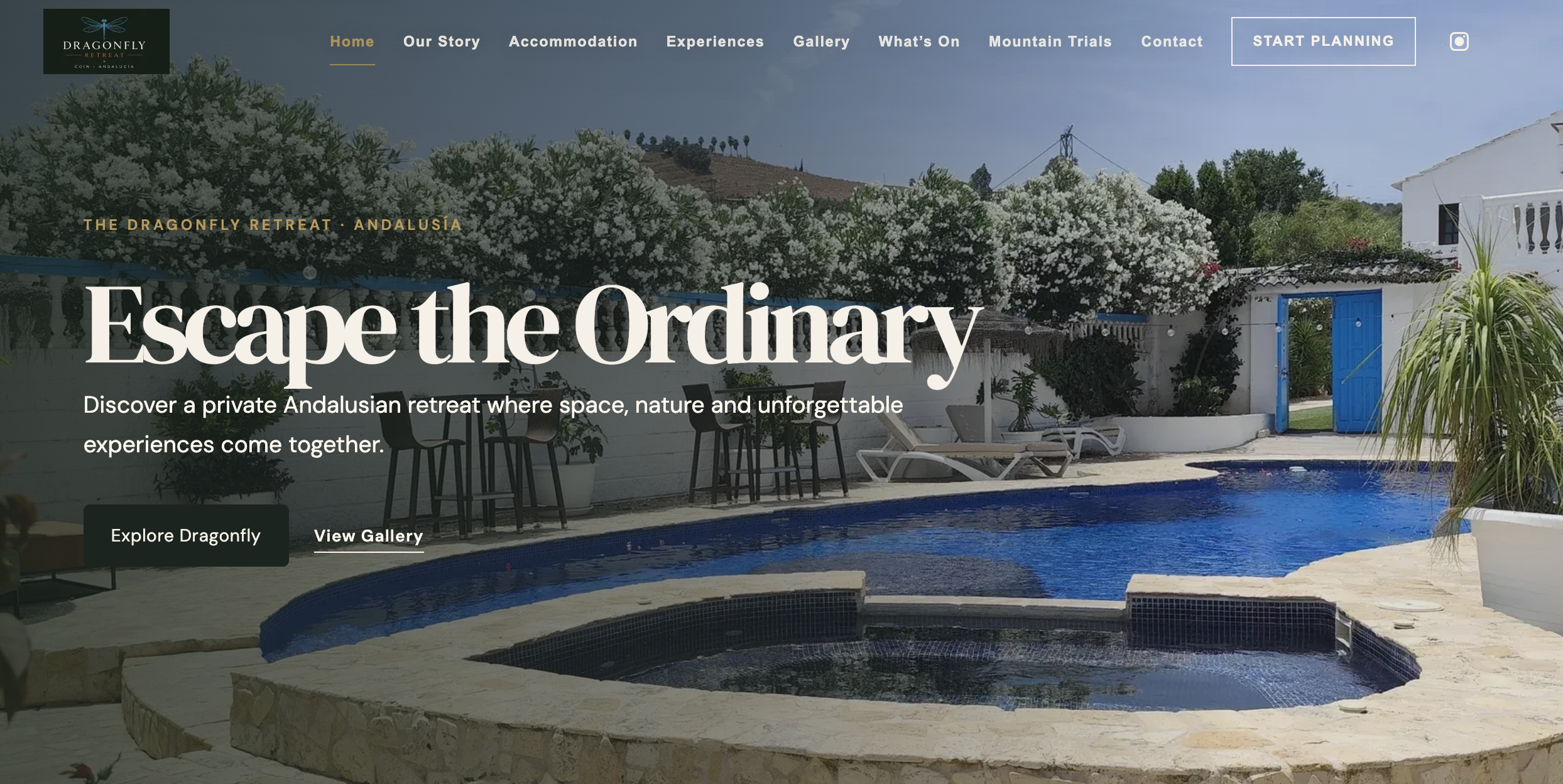
It suits retreat leaders, corporate teams, creative groups, families and friends celebrating something together, particularly anyone who has found city apartments too fragmented or hotels too impersonal for what they have in mind. You can explore Plan Your Own Group Experience to see how a bespoke stay is put together, or get in touch directly to talk through dates, numbers and what your group is hoping to do.
Sources
For regulations, consult Málaga’s council communiqués and its urban-planning technical documentation. For booking practicalities, this step-by-step group booking guide offers a useful checklist model, alongside local hen and group accommodation guidance.
- Hen Do Accommodation Málaga | Gorgeous Stays That Welcome Groups
- COMUNICADO — Málaga City Council (BOP publication on modification of Plan General)
- Spain
- PL52-2024 technical documentation — Málaga urban planning
FAQ
Where to avoid staying in Malaga?
Dense residential zones in parts of the city centre now carry restrictions on new tourist-use licences, which can limit or complicate short-term group rentals there, according to Málaga’s council. It is worth confirming a property’s lawful status in writing before booking any central apartment for a group.
Where can I find large group accommodation in Spain?
Dedicated group venues and countryside retreats, such as properties near Coín in the Málaga countryside, are generally better suited to large groups than standard hotels or city apartments, since they offer exclusive use and shared communal space. Booking guides also recommend checking a provider’s specific group policy before committing, as outlined in local accommodation guidance.
What is the best area of Malaga to stay in?
It depends on what your group wants: the city centre suits those prioritising nightlife and culture, beach districts like Pedregalejo suit relaxed coastal days, and the countryside near Coín suits groups wanting privacy and exclusive-use space. Transport links across these areas are generally strong, with the airport close to the city centre and road and rail connections reaching inland towns, per Spain’s official tourism information.
What is the most posh part of Málaga?
Areas within the historic city centre and parts of the coastline are generally seen as the more upmarket parts of Málaga, though “posh” is subjective and varies by what a visitor values. For a private group prioritising space and exclusivity over city prestige, a countryside venue often delivers more of what matters for a shared stay.
How far in advance should I book group accommodation in Málaga?
For summer and peak holiday periods, booking six to eight weeks ahead is a sensible minimum, based on local group booking guidance. Confirm whether your deposit is refundable before you pay, since terms vary significantly between hosts and venues.