DRAGONFLY JOURNAL
Cooking Team Building Ideas for Corporate Retreats in Andalucía
Cooking Team Building Ideas for Corporate Retreats in Andalucía

Cooking team building activities work because they give colleagues a real task with a real outcome, not an abstract “trust exercise” nobody remembers by Friday. For connection and bonding, book a chef-led class. For communication under pressure, run a mystery-box challenge. For remote inclusion, send matched virtual kits. For values-driven teams, pick a charity bake. Whichever you choose, sort dietary needs and book your facilitator early: both are the most common reasons a good idea falls flat on the day.
TL;DR:
In-person cooking activities should be carefully matched to team objectives, group size, and dietary needs, with early planning to avoid logistical issues.
Roles such as head chef, sous-chef, and negotiator are essential to replicate professional kitchen dynamics and promote negotiation and leadership.
Virtual or hybrid formats require matching ingredient kits and structured breakout sessions, with shorter, more frequent sessions recommended for remote teams.
Safety practices, including hygiene, allergen management, and supervision, are critical to ensure a secure and inclusive cooking environment.
A multi-day retreat offers deeper behavioral insights and lasting team development compared to single workshop sessions.
Table of Contents
-
Why cooking activities can work well for team building
-
20 practical cooking team building ideas with planning notes
-
How a hosted retreat handles the details: The Dragonfly Retreat example
-
How roles turn a cooking session into a real exercise in negotiation
-
Tips for fostering collaboration and communication during the cook
Why cooking activities reliably build teamwork
Kitchens impose the same pressures that real projects do. There’s a fixed amount of time, a shared set of equipment, and a result everyone has to live with together. That combination forces the same behaviours you’d want to see in a project sprint: someone has to decide who chops and who plates, someone has to speak up when the timing’s slipping, and someone usually steps into a leadership role nobody assigned them.
That’s precisely the value. Culinary team building gives colleagues a genuine shared task with a tangible, delicious result, and it reliably surfaces communication, leadership, adaptability and trust in a way that a lecture or a trust-fall exercise simply can’t replicate, according to Palate Team Building. Sessions built this way typically run several hours, including time to actually sit down and eat together, which turns out to matter more than the cooking itself.
A cooking challenge works differently from a regular cooking class precisely because it’s built around time limits, judging criteria or objectives that force people to coordinate, rather than simply following a recipe together.
That distinction, drawn out by Palate Team Building, is worth sitting with before you book anything. A relaxed pasta-making session with a chef narrating each step is pleasant, but it’s not the same tool as a competitive brigade challenge where teams have to negotiate who’s in charge of the sauce. Both have their place. Knowing which one you’re actually running matters more than the recipe.
Kitchens are also unusually inclusive by design. A kitchen offers multiple meaningful jobs at once. Someone chops, someone times the oven, someone tastes and adjusts seasoning, someone plates for presentation, according to Palate Team Building. A quieter team member who’d never volunteer to lead a brainstorm can happily take charge of plating without ever being put on the spot in front of the group.
There’s also good practitioner evidence that culinary formats generate longer conversations and more durable behavioural shifts than generic social mixers. Cooking together on neutral ground tends to promote role negotiation, emergent leadership and creative problem-solving under mild time pressure, and that behaviour change tends to outlast the day itself, according to Naboo’s research on culinary team building. The mechanism isn’t magic. It’s simply that cooking gives people a low-stakes reason to negotiate roles they’d normally avoid discussing directly at work.
Match your objective to the right culinary format
Not every cooking activity suits every team, and picking the wrong one is the single most common planning mistake. Before you book anything, run your options through five quick filters.
-
Objective: are you building trust between strangers, sharpening communication under pressure, or rewarding a team that’s already close?
-
Energy and culture: does your team enjoy friendly competition, or would a scoring system make quieter colleagues shut down?
-
Group size: small teams (under 15) can work as one unit; larger groups need sub-teams and more structured roles to avoid chaos.
-
Accessibility and dietary needs: confirm allergies, mobility constraints and any preference for standing versus seated tasks before you choose a format.
-
Budget and time: a two-hour lunchtime session and a full evening event call for entirely different formats and cost structures.
Once you’ve answered those five, the mapping gets simple. New or mixed-department teams that need to build basic rapport do best with a chef-led class, where the stakes are low and everyone learns together. Teams that already know each other but struggle with communication or decision-making under pressure benefit far more from a mystery-box or MasterChef-style challenge, which forces negotiation over roles and timing. Teams looking for shared purpose, particularly around a company value or CSR goal, respond well to a bake-for-charity format. And distributed teams need virtual or hybrid kits matched carefully so nobody’s cooking a different dish to everyone else on the call.
Here’s a quick scenario. Say you’re planning a session for a 30-person sales team that’s just merged with another division, and the goal is genuine cross-team bonding rather than competition. Running the group as one unit through a mystery-box challenge would be a mistake. The scoring element rewards the confident cooks from one division over the quieter half from the other, which entrenches exactly the divide you’re trying to close. A chef-led class split into mixed six-person tables, each learning to make the same three-course meal together, does the job far better.
14 practical cooking team building ideas with planning notes
“How to use food and cooking as a relaxed team-building element during a private corporate retreat.”
These culinary team challenges span every group size, budget and energy level. Each entry notes why it works, roughly how many people it suits, how long to allow, and one thing to flag for accessibility or dietary planning.
-
Mystery box challenge. Teams get a box of surprise ingredients and a time limit to build a dish, then present it to judges. It teaches negotiation and creativity under pressure and typically runs two to four hours including briefing, cooking, plating and judging, using roles such as head chef, sous-chef and negotiator, according to Teambuilding. Works for 8 to 60 people split into small brigades. Offer a vegetarian-friendly ingredient set as one of the box options.
-
Chef-led pasta-making class. Hands-on, low-competition, and universally popular. Good for new teams who need low-stakes bonding rather than a scoreboard. Suits 6 to 40 people. Fresh pasta is naturally egg-heavy, so flag an egg-free dough option in advance for allergies.
-
Sushi-rolling workshop. A precision-based class that rewards patience and steady hands rather than speed. Works well for teams that find competitive formats stressful. Fits 8 to 30 people comfortably around a shared table. Offer cooked-fillings-only rolls for anyone avoiding raw fish.
-
Bread-making class. Slower-paced and genuinely meditative, with long stretches of kneading and waiting that naturally encourage conversation. Good for 6 to 25 people. Gluten-free dough behaves differently, so ask your facilitator to run it as a separate small station rather than an afterthought.
-
Cocktail or mixology masterclass. High energy, sociable, and easy to pair with an evening dinner. Suits 10 to 60 people. Always build a full non-alcoholic menu alongside the cocktail list, not a single default “mocktail.”
-
Farm-to-table cooking day. Teams visit a market or farm, select ingredients, then cook with what they’ve bought. Strong for teams that enjoy an outdoor or exploratory element beyond the kitchen. Best for 8 to 40 people. Build in a seated rest option for anyone with mobility constraints during the market-walking portion.
-
Edible art or plating challenge. Teams design and build an edible sculpture or elaborately plated dish rather than a full meal. Great for creative teams and requires almost no cooking skill. Suits 10 to 50 people. Naturally accessible since there’s no heat or knife work required, making it a strong option for mixed-ability groups.
-
Tea or coffee masterclass. A gentler, sensory-focused session covering tasting, brewing techniques and pairing. Good as a lower-energy add-on to a longer day. Fits 8 to 40 people. Easy to run fully caffeine-free for anyone who needs it, with no substitution awkwardness.
-
Scavenger-market challenge. Teams race against a list to source specific ingredients from a market or grocery store, then cook with them. High energy and physically active. Suits 10 to 40 people. Offer a “researcher” role for anyone who’d rather plan the route than walk it.
-
Low-fi icebreaker cook-along. A short, simple recipe (think guacamole or a basic salsa) run as a warm-up before a bigger event. Works for any group size and needs almost no equipment. Genuinely the easiest format to run allergy-safe, since ingredients are few and simple to swap.
-
Regional cuisine deep-dive. A themed class exploring one region’s cooking, paired with context about the culture or history behind the dishes. Good for teams that enjoy learning alongside doing. Suits 10 to 40 people. A strong option for global or multicultural teams to rotate ownership of the theme each time.
-
Trivia-boosted cooking challenge. Teams answer culinary trivia questions to unlock premium ingredients mid-challenge, adding strategic depth beyond pure cooking skill. This keeps larger or less confident-cook teams competitive, since Froggy Events notes it stops culinary skill alone from deciding the winner. Suits 20 to 80 people. Great for including non-cooks who’d rather answer questions than hold a knife.
-
Paella evening. A single large communal dish cooked outdoors and shared family-style, built around slow cooking and conversation rather than competition. Works particularly well for groups who’ve had a busy, structured day and want to unwind together. Suits 10 to 40 people. Simple to adapt with a vegetable or seafood-free version cooked alongside the main pan.
-
Dessert or pastry challenge. A focused, lower-pressure competitive round centred purely on sweets, often used as a lighter closing activity after a heavier main event. Suits 10 to 50 people. Nut allergies are common in pastry work, so confirm a nut-free station well ahead of the day.
Operational checklist: timeline, budget and venue
Turning a chosen idea into a smooth event comes down to timing, budget clarity and a genuinely usable venue. Get these three right and the format almost looks after itself.
For in-person events with 30 or more people, start planning roughly eight weeks out. That gives you time to confirm a venue, brief a chef or facilitator, survey dietary needs, and order any specialist equipment. For smaller in-person sessions or virtual kits, two to three weeks is usually enough, though virtual kits still need shipping lead time built in.
| Timeline milestone | Large in-person event (8 weeks) | Small or virtual event (2–3 weeks) |
|---|---|---|
| Confirm format and headcount | Week 1 | Day 1–2 |
| Send dietary and accessibility survey | Week 1–2 | Day 2–3 |
| Book chef, facilitator or venue | Week 2–3 | Week 1 |
| Finalise menu and roles | Week 5–6 | Week 1–2 |
| Ship kits (virtual only) / confirm equipment | Week 6 | Week 2 |
| Run event | Week 8 | Week 2–3 |
Budget tends to break into four buckets: facilitator or chef fees, ingredient sourcing, venue hire (if you’re not using existing office space), and kit shipping for any remote participants. Larger, more theatrical formats like an Iron Chef-style competition cost more per head than a simple bread-making class, mostly down to judging equipment and ingredient variety rather than the venue itself.
On the venue side, work through this shortlist before you book:
-
Confirm the space has enough induction hobs or cooking stations for the number of sub-teams you’re running, not just the headcount.
-
Check power capacity if you’re bringing in extra appliances, particularly for outdoor or marquee setups.
-
Walk the space for workstation spacing. Cramped kitchens kill the collaborative energy you’re paying for.
-
If cooking outdoors (a paella evening, for instance), have a weather contingency and shaded seating for anyone who needs it.
-
Build in at least one non-cooking role per team (researcher, presenter, taster, plater) so anyone with mobility or dexterity constraints has a genuinely meaningful job, not a token one.
Pro Tip: Successful teams spend the first fifteen to twenty minutes purely on ideation and deciding who’s doing what, before anyone touches heat. It’s the step most first-time organisers skip, and it’s usually why the confident cooks end up doing everything while everyone else watches.
Common pitfalls that spoil culinary team building
Most failed cooking events trace back to the same handful of avoidable mistakes.
-
Surveying dietary needs too late. Sending the allergy and dietary form a week before the event, rather than at booking stage, forces last-minute menu changes that stress your chef and exclude guests.
-
Skipping role definition before cooking starts. Teams that dive straight into chopping without agreeing who’s leading what tend to end up with one person doing everything and everyone else standing around.
-
Choosing overly competitive formats for fragile or mixed-seniority teams. A scoring system that pits a junior team member against a senior one in front of judges can do more damage than good.
-
Weak facilitation and unclear rules. If nobody’s explaining the brief clearly or enforcing time limits, teams disengage fast and the exercise collapses into a normal cooking class with none of the intended structure.
-
Logistics gaps. Not enough chopping boards, one working oven for six teams, or virtual kits that arrive with mismatched ingredients across households, all of which turn a promising idea into a frustrating afternoon.
Every one of these is fixable with earlier planning, not more budget. The fix is almost always time, not money.
How to evaluate outcomes and run a short debrief
Measuring a cooking event doesn’t need anything elaborate. Set your objective before the day (better cross-team communication, stronger CSR identity, faster decision-making under pressure), then track it with a light pre and post self-assessment survey plus a same-day engagement score.
During the event itself, watch for two signals: how often roles rotate within each team, and whether communication patterns shift as time pressure increases. A team where the same person gives every instruction from start to finish hasn’t practised anything new.
-
Observation: note what actually happened in the room (who led, who stayed quiet, where friction showed up).
-
Evidence: tie it to something concrete, a specific moment or decision, not a vague impression.
-
Workplace link: ask the group directly how that pattern shows up back at their desks.
-
Next steps: agree one specific behaviour to try in the next real project meeting.
A ten-minute debrief works well with three questions: “Who ended up leading, and was that planned?”, “What would you do differently with the same box of ingredients?”, and “Where did we see this exact dynamic play out at work recently?” Cooking sessions that build in dedicated time to sit and eat together tend to produce the richest answers here, since the shared meal is where the real conversation happens, according to Palate Team Building.
How a hosted retreat handles the details: The Dragonfly Retreat example
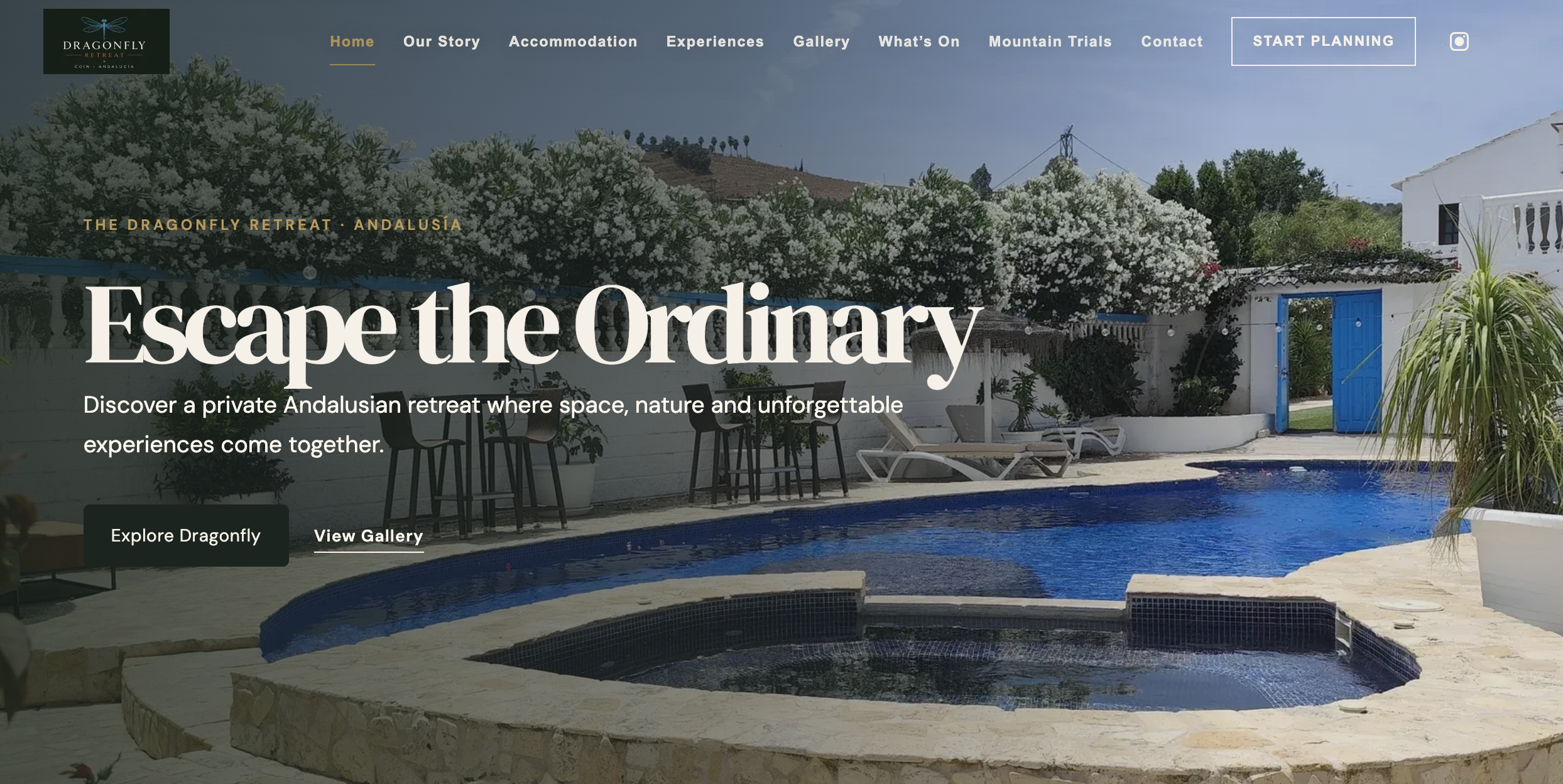
Booking a hosted retreat shifts the logistics load away from the planner entirely. At The Dragonfly Retreat, near Coín in the Andalusian countryside close to Málaga, a group arrives to find accommodation, communal spaces, gardens and a pool already organised, with bespoke culinary evenings, chef facilitation and dietary management built into the stay rather than bolted on separately.
The bigger advantage over a single offsite session is time. A two-hour mystery-box challenge back at the office gives you one data point on how your team behaves under pressure. A multi-day stay where the same group cooks together, eats together and shares communal space repeatedly gives you several, and the behaviours you saw on day one (who led, who stayed quiet) either repeat or shift by day three, which tells you something a single afternoon never could.
Mediterranean-format evenings, such as a paella evening cooked and shared outdoors or a farm-to-table meal built around locally sourced ingredients, work particularly well as the anchor moment of a longer stay. They’re framed here as example formats The Dragonfly Retreat can build into a bespoke itinerary, not a fixed menu, since every group’s activities and meal planning are arranged around their specific dates and preferences.
Pro Tip: If you’re weighing a single afternoon event against a multi-day retreat, ask yourself which behaviour you actually need to see repeated. A one-off session shows you a snapshot; a longer shared stay shows you a pattern, which is far more useful when you’re trying to change how a team actually works together.
How roles turn a cooking session into a real exercise in negotiation
Assigning clear roles is what separates a cooking challenge from a cooking class, and it’s worth being deliberate about who plays what. The classic structure borrows directly from a professional kitchen brigade: a head chef who owns the final decision and timing, a sous-chef who manages the practical execution and keeps the team on schedule, and a negotiator who liaises with judges or facilitators over rule questions and ingredient trades. Defined roles like these mirror cross-functional teamwork back at the office and make the usual unspoken negotiation over “who’s actually in charge here” explicit and visible.
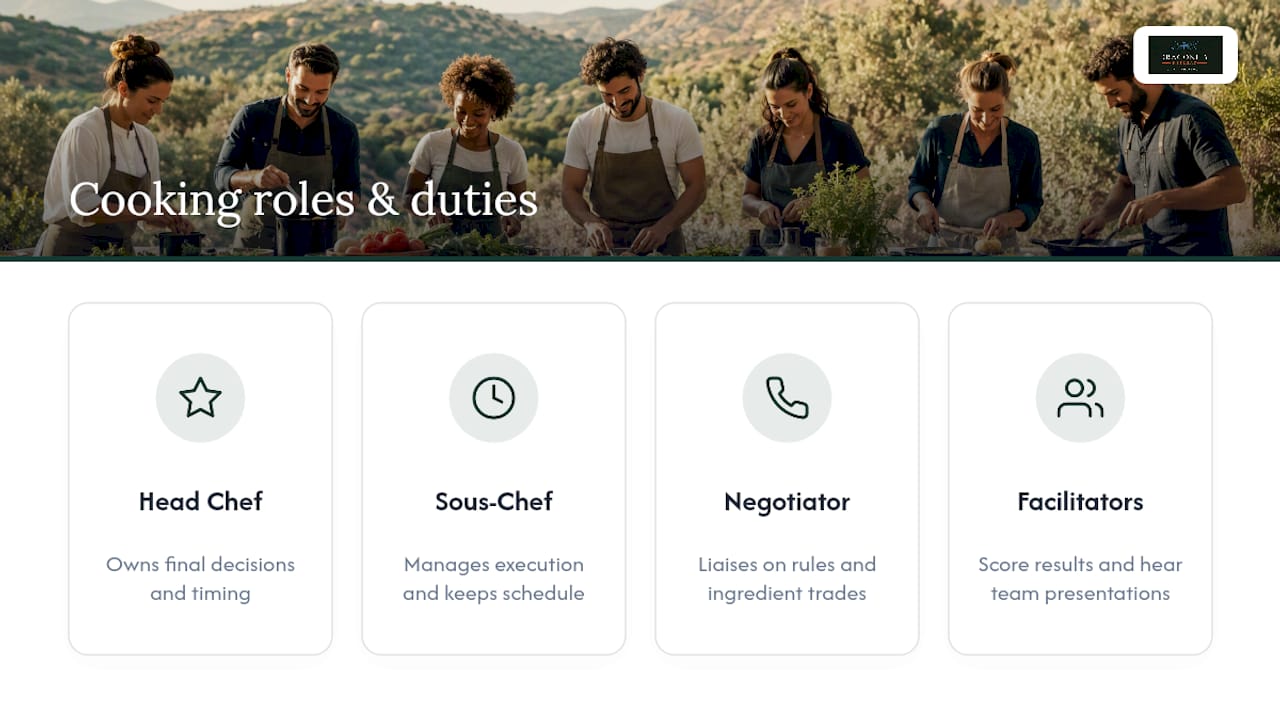
Judges matter more than most planners expect. A facilitator or a small panel scoring the results, paired with a short presentation from each team, turns the cooking itself into a conversation about decision-making and trade-offs: why did you choose speed over presentation, why did you split the team the way you did. That conversation is often more valuable than the dish.
Rotate roles across multiple events rather than letting the same confident person become head chef every time. And don’t force the assignment. Let teams self-select in the first few minutes, then have your facilitator step in only if one person is dominating or nobody’s stepping up. The negotiation over who does what is, in itself, the exercise.
Tips for fostering collaboration and communication during the cook
“One useful way to encourage communication during a cooking activity is to introduce gentle time pressure, without making the experience stressful.”, not aggressively. A tight but fair deadline forces teams to talk faster and more directly than they would in an open-ended session, without tipping into stress that shuts quieter people down.
Give every team a shared, visible checklist or recipe card rather than verbal instructions alone. It gives people something concrete to point at and disagree about, which is often easier than raising a concern out loud. Encourage a brief “huddle” moment two or three minutes in, where the team pauses to confirm who’s doing what before committing to the cooking itself, rather than letting the first person to grab a knife define the whole team’s approach by accident.
Facilitators should circulate rather than hover at one station, and should ask open questions (“what’s your plan for the next ten minutes?”) rather than giving instructions. That keeps the coaching light-touch and keeps the team owning its own decisions. Building in one deliberate “swap” moment, where two people trade tasks halfway through, also surfaces communication gaps fast: whoever’s picking up the new task has to ask questions, and whoever’s handing it off has to explain their reasoning clearly.
Adapting cooking team building for remote and hybrid teams
Virtual kits are only the starting point for remote culinary team building, not the whole solution. A live video-led session works far better when it’s built around genuine interaction rather than simply watching a chef cook on screen.
Break remote groups into breakout rooms of three or four before the main cooking segment starts, mirroring the small-brigade structure used in person, so people are talking to each other rather than just watching a shared screen. Assign a rotating “presenter” role per breakout room who reports back to the main group at set intervals, which keeps energy up across a longer session and gives quieter participants a defined moment to speak.
For hybrid groups split between an office and home, run parallel stations rather than treating the in-person group as the “real” event and the remote group as an afterthought. Match ingredient kits precisely so both groups are cooking the same dish at the same pace, and have your facilitator address both groups equally rather than defaulting to the room with people physically present.
Consider running a shorter, more frequent format for distributed teams rather than one long annual event. A 90-minute cook-along every quarter tends to build more consistent rapport across time zones than a single elaborate session that half the team has to attend at an awkward hour.
“For teams able to meet in person, a shared residential retreat offers a very different experience, with the benefit of meals, downtime and activities happening naturally across several days.”Safety and hygiene practices for team cooking events
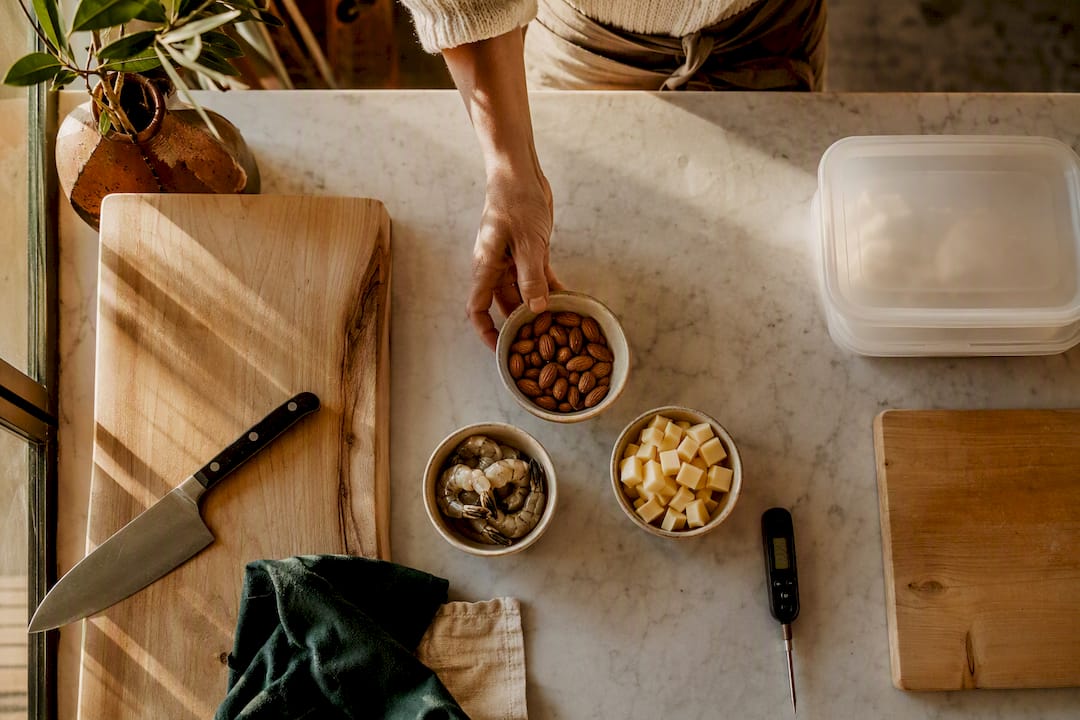
Food safety isn’t optional, and it’s easy to overlook when the focus is on team dynamics rather than the kitchen itself. Brief every participant on basic hygiene before cooking starts: handwashing, no cross-contamination between raw meat and other ingredients, and clear separation of any allergen-containing stations.
Appoint a facilitator or chef with genuine food safety knowledge to oversee the space, not just run the challenge. They should check that perishable ingredients are kept at safe temperatures throughout, particularly for events running several hours or held outdoors in warm weather. Have a clearly labelled station for any allergen-heavy ingredients (nuts, shellfish, dairy) so cross-contact risk stays low, and make sure knives, hot equipment and open flames are only used under proper supervision, especially in mixed-ability groups.
For virtual kits, include clear food safety guidance in the shipped materials, since participants are cooking unsupervised in their own kitchens. A simple one-page sheet covering storage temperatures and use-by expectations for the shipped ingredients avoids problems that a facilitator can’t catch remotely. Finally, always have a basic first-aid kit accessible on-site for in-person events. “As with any group cooking activity, minor cuts or burns are possible, so basic first-aid supplies should be readily available.” in any group kitchen setting that it’s worth having supplies ready rather than scrambling if something happens.
How to book a hosted culinary retreat for your team
“If your team is looking for a private group stay with space to eat, relax and spend time together, The Dragonfly Retreat offers accommodation, gardens, communal areas and a pool in the Andalusian countryside near Coín and Málaga. Group meals, culinary activities and dietary requirements can be discussed as part of planning the stay, depending on the group’s needs and the arrangements made.”
For a corporate team weighing a single afternoon mystery-box session against something with more depth, a hosted stay gives you the shared meal, the communal downtime and the repeated interaction that a two-hour event simply can’t fit in. “If you’re planning an evening around a shared meal, live music or relaxed entertainment can add another layer to the experience and help the group move naturally from activity into celebration.”
“To start planning, contact The Dragonfly Retreat with your preferred dates, group size and the kind of experience you’d like to create. We can then discuss accommodation, meals, activities, music and other options and shape a stay around your group rather than forcing you into a fixed package.”, and expect a bespoke quote built around your specific itinerary rather than a fixed package.