
DRAGONFLY JOURNAL
UK Organisers: 5 Operational Checks for a Private Retreat in Málaga
UK Organisers: 5 Operational Checks for a Private Retreat in Málaga

Choosing a private retreat venue near Málaga comes down to five checks: capacity and room mix, the quality of indoor and outdoor session spaces, catering flexibility, how much the host team handles for you, and proof of proper registration. One relevant option for organisers who want privacy, gardens, a pool and tailored group experiences within reach of Málaga and Marbella is a boutique exclusive-use countryside venue near Coín. The sections below walk through the checklist and the practical steps to apply it.
TL;DR:
- Ensure the venue’s capacity matches your group size, including sleeping arrangements, room types, and age restrictions, to prevent overcrowding or discomfort.
- Confirm that indoor and outdoor session spaces have good acoustics, flexible layouts, and are weather-protected for planned activities.
- Verify catering can accommodate allergies and dietary requirements, and ask about meal timing to align with your schedule.
- Check the venue’s registration, insurance, and safety documentation to meet legal standards and ensure group protection during the retreat.
- Clarify if the venue offers active support such as activity coordination, transportation, and personalized arrangements to reduce organizer workload.
Table of Contents
- What to check when comparing retreat venues
- Travel, entry and safety checks for UK organisers
- Do the facilities and programming match your retreat’s aims?
- What to get in writing before you book
- Your pre-arrival and day-one risk checklist
- How close is the venue to Málaga and the coast?
- Privacy and noise: what exclusive use actually gives you
- Does the venue offer concierge-style support, or are you on your own?
- What previous guests say matters, but ask the right questions
- How The Dragonfly Retreat fits the checklist
- FAQ
- Sources
What to check when comparing retreat venues
Before you fall for a photogenic garden or an infinity pool, run every shortlisted property through the same operational checklist. A venue that looks right in pictures can still fail a group of 14 if the bedrooms are poky or the kitchen cannot turn around three meals a day.
- Capacity and room mix: ask how many can sleep comfortably, whether rooms are single or shared, if extra beds can be added, and whether there are age restrictions for younger guests.
- Session spaces: count the indoor and covered outdoor areas available for workshops, note the acoustics, and ask about breakout options for smaller group work.
- Catering: find out whether meals come from an in-house cook or a contracted chef, request sample menus, and confirm how allergies and buffet labelling are managed.
- Group flow: look at how communal areas, private corners, garden access and the pool fit together, since this shapes the rhythm of a multi-day programme.
- Host support: establish how much logistical help is included, from transfers to local suppliers to activity coordination, and ask for evidence of established local ties.
- Practical facilities: confirm reliable Wi-Fi, parking for the group’s vehicles, laundry provision and accessible bathrooms.
Venues with genuine local relationships, ties to food producers, activity providers and guides in the surrounding countryside, tend to deliver a more authentic experience with less effort from the organiser, according to a guide to rural property standards in Andalusia. That local integration also tends to reduce the number of problems you have to solve yourself mid-retreat.
Pro Tip: Ask any shortlisted venue for a sample day-by-day schedule from a previous group booking. It tells you more about real capacity than any brochure.
Travel, entry and safety checks for UK organisers
A beautiful venue is only useful if your group can get there without a visa headache or an uninsured hire car. A handful of practical checks protect you and your participants before you commit.
- Check the Schengen 90-day rule: British citizens can travel to Spain visa-free for up to 90 days in any 180-day period, and organisers should ask participants to carry booking confirmations and proof of travel insurance.
- Confirm driving arrangements: UK photocard driving licences are valid in Spain, but provisional licences are not, so anyone hiring a car for airport transfers needs a full licence, proof of insurance, and a child seat booked in advance for passengers under 135cm.
- Ask the venue for evidence of registration under Andalusian tourism rules, which define categories and minimum standards for rural accommodation, along with basic fire and safety documentation.
- Request the venue’s public liability and activity-specific insurance certificates, and check your own group’s travel cover extends to any planned excursions or workshops.
These checks take an afternoon but save considerable stress once a group of twelve or more has landed.
Do the facilities and programming match your retreat’s aims?
A venue’s spaces and catering need to match what you are actually planning to run, not just look appealing in photographs. Weather contingency matters as much as atmosphere: a covered outdoor terrace that converts a sunny morning session into a sheltered one when cloud rolls in is worth more than a beautiful but exposed lawn.
- Movable furniture, good sightlines and workable acoustics separate a genuinely retreat-ready room from a pretty but impractical one.
- For catering, ask about meal timing around your schedule and how buffets handle dietary needs, since labelling in more than one language helps mixed-nationality groups self-serve with confidence.
- Shared-plate meals such as a Mediterranean feast or a paella evening work well for group bonding, provided the kitchen can confirm timings around your sessions.
- Ask whether the host runs excursions and activities directly or arranges vetted local suppliers, since this affects both cost and how much coordination falls to you.
- Check operational capacity too: staff-to-guest ratios at mealtimes, kitchen turnaround between courses, and any quiet hours that might affect an evening celebration.
Pro Tip: If your retreat includes an evening celebration or live music, ask about quiet hours and neighbouring properties before you build the final night around it.
What to get in writing before you book
Verbal reassurances are not enough for a multi-day group booking. A proper contract or written agreement should cover the following points clearly.
- Confirmation of exclusive use, including any minimum number of guests or minimum spend that applies.
- A clear list of what is included (meals, staff, cleaning, bed linen) versus optional extras, and how payments for outside suppliers are handled.
- Deposit amount, payment schedule, cancellation terms, and how a force majeure situation such as flight disruption or extreme weather would be handled.
- Who is responsible for coordinating transport, external instructors or local activity suppliers, so nothing falls between the venue and the organiser.
Getting these details in writing before you pay a deposit avoids the kind of misunderstanding that can derail a group of excited participants on day one.
Your pre-arrival and day-one risk checklist
A short checklist in the final weeks before arrival catches the problems that are easy to miss amid the excitement of final planning.
- Confirm emergency contacts and the nearest medical facility, and ask the host for written evacuation and emergency procedures.
- Collect insurance certificates and any signed risk assessments for planned activities such as hiking, cooking demonstrations or water-based sessions.
- Check on-site security arrangements, including gate and lock procedures, parking capacity for the group’s vehicles, and transfer timetables.
- Run a welcome briefing on arrival that confirms room allocations, dietary arrangements and a basic property inventory.
Pro Tip: Build 30 minutes into day one for this briefing. It sets expectations for the whole group and flags any last-minute dietary or accessibility needs before the first meal.
How close is the venue to Málaga and the coast?
Proximity matters for two reasons: it determines airport transfer time for arriving guests, and it decides how easy day trips or coastal excursions will be during the retreat. A countryside venue that sits too far from any town can leave a group feeling cut off if someone needs a pharmacy or a change of scenery.
A boutique exclusive-use countryside venue near Coín is within reach of both Málaga and Marbella, giving organisers a base that feels genuinely rural without placing the coast or an international airport out of practical reach. For a retreat built around deep focus, that quiet countryside setting works in the group’s favour. For one that also wants a half-day trip to the coast or a cultural outing into Málaga itself, the same location keeps those options realistic without building hours of travel into the schedule.
When you compare venues, ask not just “how far in kilometres” but “how long by road, and what’s the drive like.” A winding mountain route can turn a short distance into a longer journey than a straight coastal road covering twice the distance.
Privacy and noise: what exclusive use actually gives you
Exclusive use means your group has the property to itself, no other guests checking in, no shared breakfast room with strangers, no competing bookings for the pool or garden. That matters enormously for retreats built around vulnerable conversations, creative work, or simply the chance to switch off without an audience.
Noise works both ways. A private venue protects your group’s sessions and celebrations from outside disruption, and it also means your group’s own noise, whether that’s a music evening or an early morning yoga session, does not need to be managed around other paying guests. That said, any countryside property still sits within a wider landscape, so it is fair to ask a host about neighbouring properties and any practical limits on amplified sound in the evening.

An exclusive-use model, with gardens, pool and separate indoor and outdoor communal spaces, is built around this kind of privacy: a group books the whole property, not a block of rooms within a larger hotel. That distinction is worth asking about directly with any venue you shortlist, since “private retreat” can mean different things depending on whether other guests share any part of the grounds.
Does the venue offer concierge-style support, or are you on your own?
The gap between a venue that simply provides keys and one that actively helps plan your retreat is significant. Concierge-style support can include arranging transfers, recommending or booking local activity providers, coordinating with external instructors, and adjusting meal plans around your group’s dietary needs.

Hosts who act as genuine facilitators, handling transport logistics, activity bookings and supplier coordination, measurably reduce the organiser’s workload and tend to produce a smoother retreat overall, as explained in Why Book Countryside Accommodation for Your Next Trip | Fox Hostel – South Iceland. That kind of support is usually worth asking about specifically: does the host run activities themselves, or simply hand over a list of local numbers?
At this venue, stays and activities can be tailored to each group’s needs, which may include personalised experiences such as Mediterranean food, paella evenings, wine tasting, art, photography and excursions around Andalucía arranged as part of the retreat. For an organiser already juggling a packed programme, having one point of contact who can adjust the plan as the group’s needs become clearer is a meaningfully different experience from renting an empty house and sourcing everything yourself.
What previous guests say matters, but ask the right questions
Reviews and reputation are useful, but for a private group venue they need interpreting differently than for a hotel. A single bad review about slow Wi-Fi matters less for a creative retreat than consistent feedback about whether the host delivered on logistics, catering and communication.
When you look at a venue’s reputation, focus on the details that affect group bookings specifically: did previous organisers mention the host’s responsiveness before arrival, how well catering matched dietary requests, and whether the property matched its description for group size and communal space. A property that photographs beautifully but draws repeated comments about cramped sleeping arrangements is telling you something a gallery of images will not.
Ask a shortlisted venue directly for references from previous group organisers, not just individual guest reviews, since the needs of a 12-person retreat differ from those of a couple on a weekend break.
How The Dragonfly Retreat fits the checklist
Working through the checklist above, this is a boutique, exclusive-use countryside venue near Coín, within easy reach of Málaga and Marbella, built specifically around group stays rather than individual bookings. Gardens, a pool, and indoor and outdoor communal spaces give a group room to spread out between focused sessions and informal downtime, and because the whole property is booked exclusively, there are no competing bookings and no shared spaces with other guests.
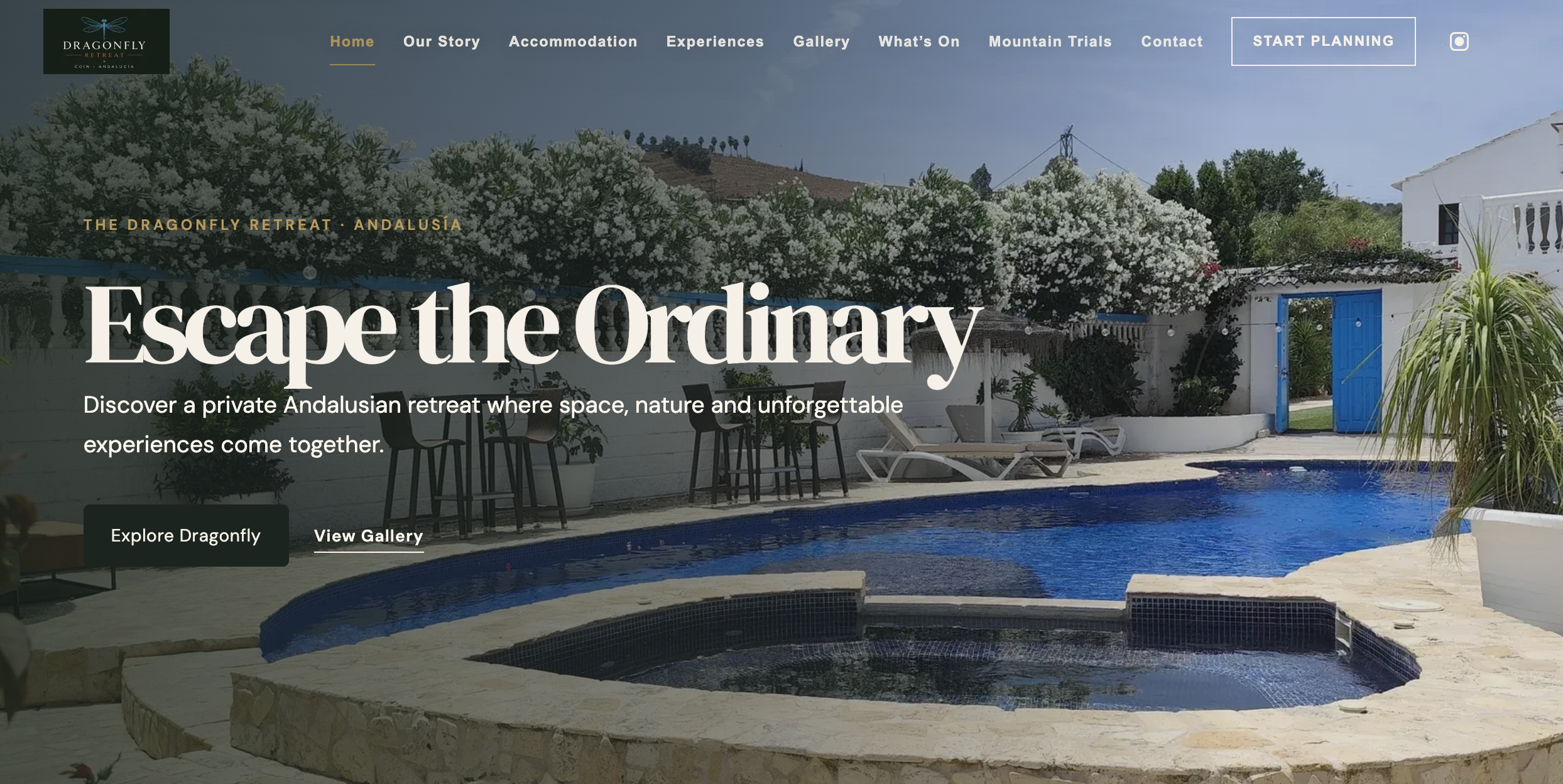
Stays and activities can be tailored to each group, whether that means a creative focus, a food and wine programme, a celebration, or a bespoke mix of all three.
- Creative Arts – Paint the Landscape for groups building a retreat around art and the Andalusian landscape.
- Cooking, Food, Wine & Mediterranean Living for groups who want catering and food experiences woven through the programme.
- Music, Vibes & Celebrations for groups marking a special occasion together.
| Checklist item | How we match it |
|---|---|
| Exclusive use and privacy | Whole-property booking near Coín, no shared guests |
| Group spaces | Gardens, pool, indoor and outdoor communal areas |
| Catering flexibility | Tailored menus including Mediterranean food and paella evenings |
| Activity coordination | Personalised excursions, wine tasting, art and photography |
If any of this matches what your group needs, the most useful next step is to get in touch through our Plan Your Own Group Experience page with your group size, preferred dates and the kind of experience you have in mind, and we will work through a bespoke quote with you from there.
FAQ
How many guests can a private retreat near Málaga typically host?
This varies significantly by venue, so the right question to ask any shortlisted property is its exact room mix and maximum comfortable capacity. Accommodation is spread across distinct rooms including suites and cottages, and the venue can discuss capacity for your specific group size.
What should I check about a venue’s legal registration?
Ask for evidence that the property is registered under Andalusian tourism rules, which set out categories and minimum standards for rural accommodation. A legitimate venue should be able to show registration documentation and basic fire and safety compliance without hesitation.
Do UK organisers need a visa to run a retreat in Spain?
No visa is required for short stays: British citizens can travel to Spain visa-free for up to 90 days within any 180-day period. Organisers should still carry booking confirmations and valid travel insurance for the group.
Can activities and catering be tailored to our group’s needs?
Yes, stays and activities can be tailored to each group, from Mediterranean food and paella evenings to wine tasting, art, photography and excursions around Andalucía. The best approach is to share your group’s size, dates and goals so a programme can be shaped around them.
What should I ask about catering for dietary needs?
Ask any venue how they handle allergies and dietary restrictions in practice, not just in principle, including whether buffets are clearly labelled and whether the kitchen can accommodate specific requests across a multi-day stay. A venue with flexible, host-led catering can usually adapt more easily than one relying on a fixed external caterer.