DRAGONFLY JOURNAL
Small Group Retreat Games: Easy Activities for Retreats in Andalucia
Small Group Retreat Games: Easy Activities for Retreats in Andalucia
The best small group retreat games are a short mix of icebreakers, quick energisers, collaborative problem-solvers and reflective exercises, chosen to match your group’s size and the session’s goal. Pick an icebreaker to warm up a group that hasn’t met before, an energiser when energy dips after lunch, a problem-solving challenge when you want the group thinking together, and a reflective exercise when the goal is depth rather than laughter. The shortlist and full run sheets below cover all four.
TL;DR:
The choice of games should match the group’s purpose, energy level, and available time, with emphasis on simple, adaptable activities.
Most activities require minimal props and are designed for indoor or outdoor use, with specific adjustments for virtual or low-mobility groups.
Effective facilitation involves clear setup, timed debriefs, and flexible responses to group dynamics such as dominant voices or discomfort.
Structured rotation and quick acknowledgment of issues help maintain flow, while the main goal is to foster connection through shared, memorable experiences.
The success of retreat games is best measured by improved group interaction, honest participation, and ongoing references, rather than formal surveys.
Table of Contents
-
Small group retreat games in practice at The Dragonfly Retreat
-
The real benefits of games at a retreat, and how to know they’ve worked
Small group retreat games: the quick shortlist
You don’t need twenty activities. You need four or five good ones, used with intent. “This shortlist covers simple activities that work well for small adult retreat groups, chosen for ease, flexibility and group connection.”
-
Two Truths and a Lie — A classic opener where each person shares three statements, two true and one invented, and the group guesses. Works for groups of 6 to 15, takes 10 to 15 minutes, needs no props, and gives quieter guests an easy way to reveal something personal without over sharing.
-
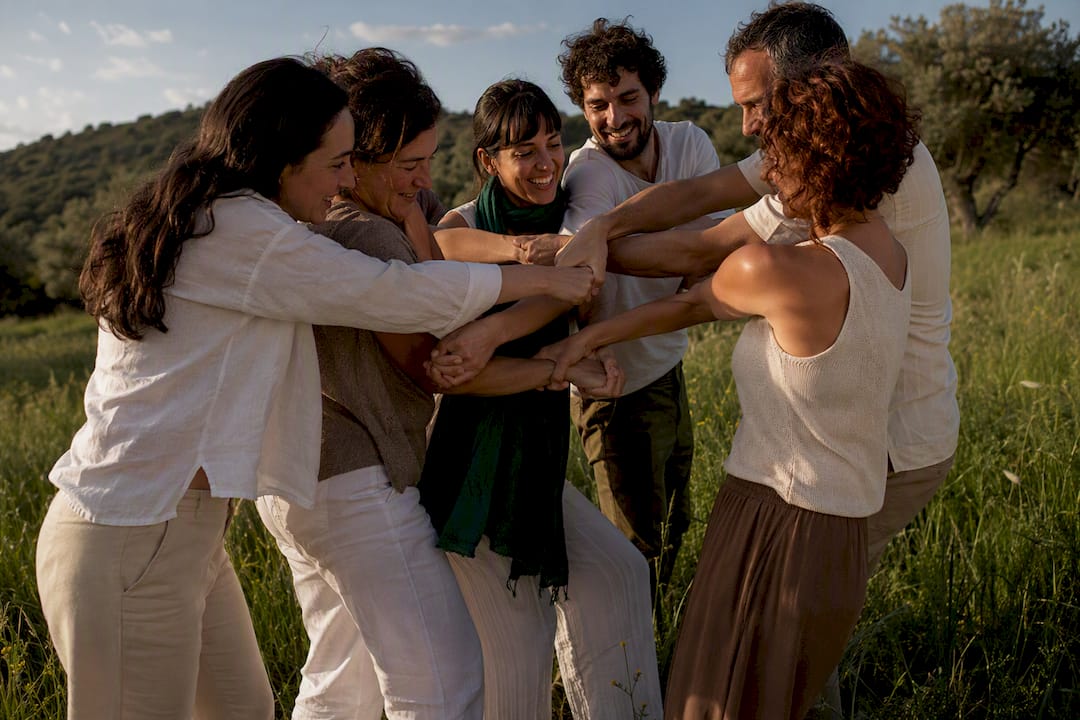
The Human Knot — Participants stand in a circle, grab two different hands across the group, then untangle themselves without letting go. The Human Knot needs no equipment and works indoors or outdoors, and it’s genuinely funny to watch a group of adults figure out they’ve formed two separate circles by accident.
-
Song Association — One person says a word, the next has to sing a line from a song containing that word, and so on round the circle. Best for 6 to 12 people, runs 10 to 20 minutes, and works brilliantly as a low-stakes energiser after a meal.
-
Categories Twist — A speed round where the group calls out items in a category (types of pasta, 1990s films) but every third go-round the category flips. Good for 8 to 15 people, 5 to 10 minutes, zero props, high laughter rate.
-
Ball Mania — A systemic challenge where the group passes multiple balls through a sequence as fast as possible, improving each round. Ball Mania needs open floor space and at least two soft balls, suits 8 to 15 people, and takes 20 to 25 minutes including a debrief. It’s one of the few games on this list built specifically to expose how a group makes decisions under pressure.
-
Life Map — Each person draws a simple timeline of key moments in their life on a sheet of paper, then shares two or three points with the group. Suits 6 to 12 people, needs paper and pens, and runs 20 to 30 minutes. This one belongs later in a retreat, not on day one.
-
Gratitude Circle — A closing ritual where each person names one thing they’re grateful for from the day or the group. No props, 5 to 15 minutes depending on group size, works for any group from 4 to 20.
-
Scavenger Hunt (small-group variant) — A list of items or tasks scattered around a garden, courtyard or nearby lanes, completed in pairs or small teams. Needs a prepared list and roughly 30 to 45 minutes, and it’s one of the better outdoor picks when a group needs to move rather than sit.
-
Back-to-Back Drawing — Two people sit back to back; one describes a simple image, the other draws it without seeing the original. Works for pairs within a group of any size, needs paper and pens, takes 10 to 15 minutes, and reliably produces the best laughs of the day.
-
Most Likely To — The group votes on who is “most likely to” complete a given scenario, from mundane to mildly cheeky. Most Likely To works best with 3 to 10 players and needs prompts calibrated to how comfortable the group already feels with each other, so save the bolder questions for day two or three.
Low-prop options worth flagging separately: Two Truths and a Lie, The Human Knot, Song Association, Categories Twist, Gratitude Circle and Most Likely To all need nothing beyond people and a bit of space. Ball Mania, Life Map, Back-to-Back Drawing and the scavenger hunt need minimal materials, listed in the run sheets below. The Human Knot, Ball Mania and the scavenger hunt are your outdoor-friendly picks if you’ve got a garden, terrace or open field to use.
Step-by-step run sheets for each game
Knowing a game’s name isn’t the same as being able to run it well. Here are full instructions for the strongest pick in each category, plus a pro tip for each.
Icebreakers: Two Truths and a Lie
Purpose: Break initial silence and reveal small, human details about each person. Group size: 6 to 15. Time: 10 to 15 minutes. Materials: None.
Setup: Sit or stand in a circle where everyone can see each other’s faces.
Play it like this:
-
Each person prepares three statements about themselves silently, two true and one false.
-
Going round the circle, each person states all three; the rest of the group votes on which is the lie.
-
The person reveals the answer and gives a one-line explanation of the true statements.
-
Continue until everyone has gone.
Debrief questions:
-
What surprised you most about someone’s answer?
-
Did anyone’s “lie” sound more believable than their truth, and why?
-
What’s one thing you’ll remember about a person here tomorrow morning?
Variation: For a virtual group, use a shared chat or breakout rooms so people can vote privately before revealing, which stops the loudest guesser dominating.
Pro Tip: Go first yourself. If the organiser shares something slightly unexpected, the rest of the group calibrates how honest they’re allowed to be.
Energisers: Song Association and Categories Twist
Purpose: Lift flagging energy, particularly after meals or long sitting sessions. Group size: 6 to 15. Time: 10 to 20 minutes. Materials: None.
Setup: Standing circle, enough space that people aren’t bumping elbows.
Play it like this:
-
One person calls a word; the next person has five seconds to sing a line from any song containing that word.
-
If they can’t, they say a new word instead and play continues.
-
Swap to Categories Twist once energy peaks: call a category, go round the circle rapid-fire, and flip the category every third round without warning.
Debrief questions:
-
Who caught you off guard with a quick answer?
-
Did the pace of the game change how loud or quiet people were?
-
What’s one word you’ll associate with this group from now on?
Variation: Indoors with limited space, run it seated with claps instead of standing, which keeps the pace without needing room to move.
Pro Tip: Cap each round at 90 seconds. Energisers lose their punch the moment they start to drag, and a strict time limit is what keeps them feeling snappy rather than tedious.
Collaborative problem-solving: The Human Knot and Ball Mania
Purpose: Force the group to solve a physical or logistical puzzle together, surfacing how they communicate under mild pressure. Group size: 8 to 15 (Human Knot works from 6 upward; Ball Mania needs at least 8). Time: 15 to 25 minutes including debrief. Materials: Two or more soft balls for Ball Mania; nothing for the Human Knot.
Setup for the Human Knot: Stand in a tight circle, everyone reaches across with both hands to grab two different people’s hands (not the person directly next to them), then the group works out how to untangle into one continuous circle without letting go.
Setup for Ball Mania: Stand in a circle with open floor space, and the group establishes a sequence for passing multiple balls through everyone at least once, then tries to beat their own time on repeated rounds.
Play it like this (Human Knot):
-
Form the circle and grab hands as described.
-
Nominate no leader; let the group self-organise.
-
Allow up to 10 minutes; if truly stuck, allow one hand-release as a lifeline.
Play it like this (Ball Mania):
-
Establish the sequence with one ball first.
-
Add a second and third ball once the sequence is smooth.
-
Run three timed rounds, encouraging the group to improve their own time.
Debrief questions:
-
Who ended up leading, and did that happen naturally or by default?
-
What did you notice about how the group handled the moment things went wrong?
-
What’s one thing this group does well under pressure that you’d want to use again?
Variation: For mixed-mobility groups, swap the Human Knot for a seated version using a length of rope passed hand to hand in a set pattern, which keeps the puzzle element without requiring everyone to stand and twist.
Pro Tip: Ball Mania and similar systemic challenges reveal unspoken assumptions the group has made about roles, so resist jumping in to help. The mess is the point.
Reflective exercises: Life Map and Gratitude Circle
Purpose: Move the group from surface fun toward genuine personal sharing, usually placed later in a retreat once trust has built. Group size: 6 to 12 for Life Map; up to 20 for Gratitude Circle. Time: 20 to 30 minutes for Life Map; 5 to 15 minutes for Gratitude Circle. Materials: Paper and pens for Life Map; none for Gratitude Circle.
Setup: Seated in a circle or around a table, “Ideally choose a quieter setting away from the earlier activities.”
Play it like this (Life Map):
-
Give everyone paper and five to seven minutes of silence to sketch a rough timeline of three to five key moments in their life.
-
Ask for volunteers to share, rather than going round in forced order.
-
Close with each person naming one thing they hope to take from the retreat, connecting past to present.
Play it like this (Gratitude Circle):
- Simply go round and each person names one specific thing they’re grateful for that day, encouraging specifics over generalities.
Debrief questions:
-
What’s one moment on your map you’d never normally mention in a first conversation?
-
Did hearing someone else’s story change how you see them?
-
What’s one thing from today you want to carry into tomorrow?
Variation: For groups uncomfortable with public sharing, let people write their gratitude on paper and place it anonymously in a bowl, then read a handful aloud without naming who wrote what.
Pro Tip: Start reflective prompts mild and only escalate once the group shows readiness. Asking for a “life highlight” on day one usually lands better than asking for a “biggest regret” before anyone’s had dinner together.
Choosing the right game and running a strong debrief
Picking a game is half instinct, half checklist. Match it to three things: your purpose (connect, energise, or deepen), your group’s current energy, and the time you’ve actually got, not the time you wish you had.
Selection rules worth keeping in your back pocket:
-
If the group has just met, start with a mild icebreaker before anything physical or emotionally exposing.
-
If energy is flagging after a meal, “If energy is flagging after a meal, a short energiser can often work better than immediately starting another discussion.”
-
If you want observable insight into how people make decisions together, a collaborative challenge like Ball Mania or the Human Knot does that job better than conversation ever will.
-
Group size is one of the biggest factors in whether a game succeeds. A game built for twenty people often falls flat with six, and vice versa.
A short facilitator checklist before you start any game:
-
Setup: props ready, space cleared, everyone can see and hear you.
-
Roles: decide if you’re playing, observing, or purely timekeeping.
-
Timekeeping: set a visible timer or phone alarm so you’re not the one dragging the pace.
-
Consent: tell the group they can opt to observe rather than participate, no explanation required.
-
Stopping rule: agree a simple signal (a raised hand, a called word) anyone can use to pause the game.
“A useful principle for facilitators is that the game itself only creates the moment; the debrief is where much of the reflection and connection can happen.”: the game itself only delivers the fun. The debrief is where the actual connection gets made. A useful, quick template is three questions:
-
What happened? (factual, low-pressure, gets everyone talking)
-
What mattered? (the observation or feeling behind the fact)
-
One action? (something small the group or person will do differently)
Debriefs work best when they stay anchored to observable behaviour rather than drifting into abstract life lessons nobody asked for. Ask “what did you notice happening” rather than “what did you learn about teamwork,” and you’ll get sharper, more honest answers.
Red flags and simple remedies:
-
One person dominates every round — reframe the rules so answers rotate by a fixed order rather than free-for-all.
-
The group goes quiet and flat — switch immediately to a physical energiser rather than pushing through with the planned agenda.
-
Someone looks visibly uncomfortable — pair them with a partner for the next round rather than putting them centre-stage again.
-
Energy is too high and it’s getting chaotic — slow the tempo deliberately; a seated round resets the room faster than shouting over people.
Pro Tip: Choose games for the kind of connection or energy you want to create, rather than simply choosing the activity that sounds the most entertaining.fun is what a game delivers, but connection is the actual outcome you’re being paid or trusted to create. Choose games with that outcome in mind, not just the laugh.
“Example session plans”
-
30-minute session: 5-minute warm-up (Two Truths and a Lie, shortened to one statement each), 15-minute energiser (Song Association into Categories Twist), 5-minute Gratitude Circle debrief, 5-minute buffer for stragglers and settling in.
-
60-minute session: 10-minute icebreaker, 30-minute collaborative challenge (Ball Mania, including two timed rounds and a proper debrief), 15-minute reflective close (short Life Map sharing, three volunteers only), 5-minute buffer.
-
90-minute session: 10-minute warm-up icebreaker, 20-minute physical energiser to lift energy, 30-minute main collaborative task (Human Knot followed immediately by a seated debrief), 20-minute Life Map reflection, 10-minute group action planning where everyone names one thing they’ll do differently this week.
Leave a five to ten minute buffer in every plan. Groups run long on the fun parts and short on transitions, never the other way round, and regular use of these formats works best when the cadence matches what the team actually needs rather than a fixed monthly habit for its own sake.
Adapting games indoors, outdoors, virtually and inclusively
The same core game usually survives a change of setting with small tweaks. Ball Mania and the Human Knot need open floor space, so move them outdoors onto a lawn or terrace whenever weather allows, and swap to a seated rope-passing version indoors if space is tight.
-
Virtual groups: run Two Truths and a Lie and Most Likely To in breakout rooms of three or four, then reconvene to share highlights; use a shared document for Life Map instead of paper.
-
Seated or low-mobility groups: Categories Twist and Song Association need zero standing; Gratitude Circle works exactly the same seated as standing.
-
Language-mixed groups: favour visual or physical games like Back-to-Back Drawing over word-heavy ones like Song Association.
-
Sensory considerations: warn the group before loud energisers or physical contact games, and always offer an observer role with no questions asked.
-
Non-speaking participation: let people contribute to Gratitude Circle or debriefs by writing on a card rather than speaking aloud, especially useful in mixed-confidence groups.
Small group retreat games in practice at The Dragonfly Retreat
At The Dragonfly Retreat, a private countryside venue near Coín in Málaga province, groups can make use of different indoor and outdoor communal areas depending on the type of activity. Quieter reflective exercises may suit a more peaceful corner, while active group games generally benefit from having more room to move.
“One possible half-day retreat schedule might look like…”: arrival and settling in, a short icebreaker over coffee on the terrace, a mid-morning energiser in the garden before lunch, then a collaborative challenge in the open lawn area once the group has warmed up to each other. A full-day schedule adds a reflective Life Map session in the late afternoon, often timed to catch the softer light before dinner, followed by a Gratitude Circle to close the day around the communal table.
Which spaces suit which games:
-
Gardens and open lawn: collaborative challenges like Ball Mania and the Human Knot, plus any energiser needing room to move.
-
Terraces: icebreakers, Gratitude Circle, and quieter conversational games.
-
Communal indoor spaces: Life Map, Back-to-Back Drawing, and any activity needing a table and pens.
Organisers planning creative or corporate retreats, celebrations or bespoke group stays can build a games schedule around whichever spaces suit their group, and “Organisers can plan their retreat around the spaces, group size, aims and pace that suit their stay.” If you’re weighing up thematic programming for a creative retreat, it’s worth looking at how other event organisers structure their sessions.
Common challenges during group games and how to handle them
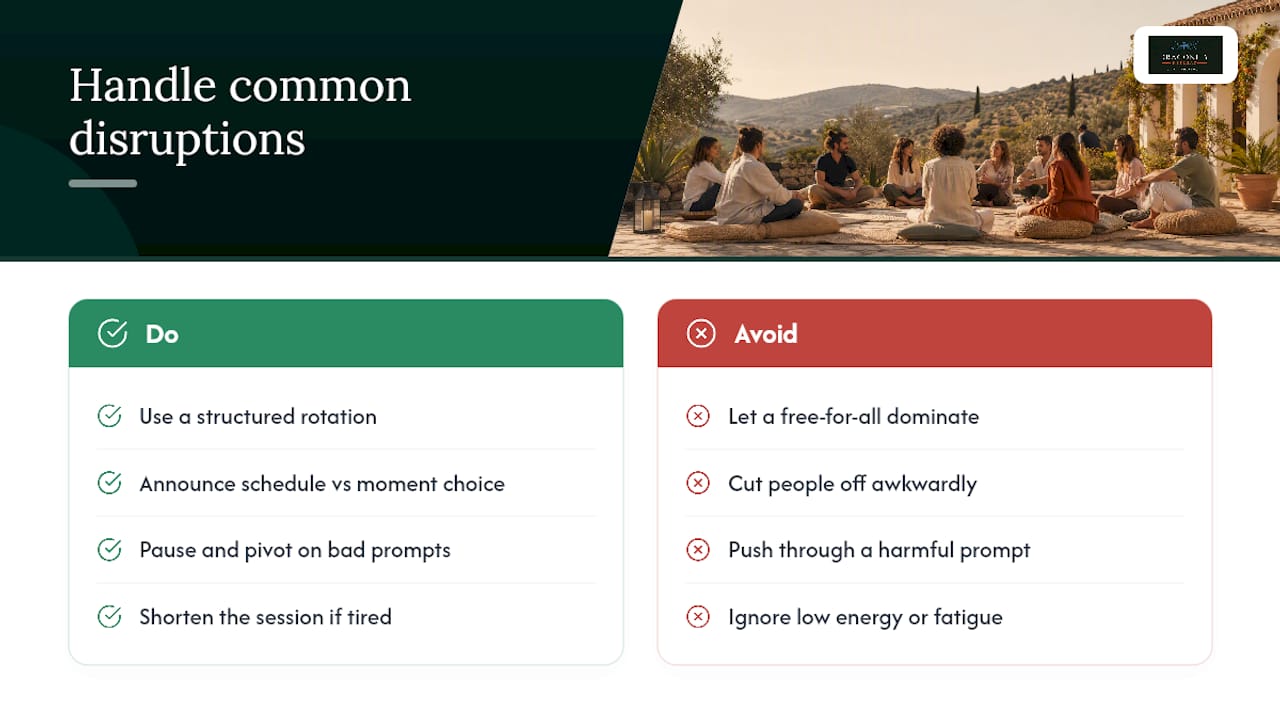
“One common challenge is uneven participation, with one or two people speaking more while quieter guests hold back.”, one or two people talking over everyone else while quieter guests retreat further into silence. Fix this by switching to a structured rotation (everyone answers in order) rather than a free-for-all, which forces balance without singling anyone out.
Another common issue: a game that was meant to take ten minutes stretches to twenty because the group is having a genuinely good time. Decide in advance whether you’ll protect the schedule or protect the moment, and say so out loud to the group rather than awkwardly cutting people off mid-sentence.
Discomfort is the trickiest one to manage well. If a prompt lands badly, a personal question goes further than someone wanted, don’t push through for the sake of finishing the round. Pause, acknowledge it lightly, and move to a neutral question or straight into the next activity. Groups forgive a quick pivot far more easily than a lingering awkward silence.
Finally, watch for the group that’s simply tired. No amount of clever facilitation fixes low blood sugar or jet lag. Sometimes the right call is shortening the session, not pushing through the plan you wrote three weeks earlier.
The real benefits of games at a retreat, and how to know they’ve worked
Games earn their place at a retreat because they create shared experiences fast, and those shared experiences are what actually build trust in a low-pressure setting, far quicker than a formal introduction round ever manages. A group that’s laughed together at a Human Knot disaster talks differently to each other for the rest of the weekend.
The benefits show up in a few concrete ways: faster warmth between people who didn’t know each other beforehand, more honest contributions during later discussions or workshop sessions, and a shared reference point (“remember the ball game”) that keeps recurring through the rest of the retreat.
Measuring impact doesn’t need a survey. Watch for whether conversation at meals gets easier as the retreat goes on, whether quieter guests start initiating rather than just responding, and whether the debrief questions produce specific, personal answers rather than vague pleasantries. If people are still referencing a game on the last day, it worked. If nobody mentions it again after lunch, it didn’t land, and that’s useful information for next time too.
Sources
A handful of sources shaped the practical detail in this piece, and they’re worth a look if you want to go deeper on any single game or on facilitation technique generally.