
DRAGONFLY JOURNAL
How to Choose Group Accommodation in Málaga for a Private Stay
How to Choose Group Accommodation in Málaga for a Private Stay

The best group accommodation near Málaga is the one where your whole group sleeps, eats and spends time under one roof, with the property to yourselves. Before you book, confirm four things in writing: exclusive use, a sleeping plan that suits your group, a comfortable shared space for everyone at once, and a realistic route from the airport. Everything else, from the pool to the catering, follows from those.
This guide is for family and friendship groups, retreat leaders and organisers booking a private stay in Málaga province and the countryside around it. It explains what to check, what to ask, and why a private countryside property often works better than a handful of separate hotel rooms.
TL;DR
- Ask for exclusive use in writing, and find out whether anyone else could be staying or hosting an event on site at the same time.
- Plan around the lowest comfortable number across sleeping, meeting and dining, not the headline capacity.
- Check bedroom and bathroom arrangements early: who shares, how far rooms are from each other, and how many bathrooms there are.
- Work out airport transfers, local driving and insurance before you pick the property, not after.
- Confirm cancellation, payment and damage terms before you collect deposits from your group.
Table of Contents
- Why stay together in one private property
- Exclusive use and privacy: what to confirm
- Bedrooms and bathrooms: the sleeping plan
- Match the venue to your group size and activities
- Pool, gardens and outdoor areas
- Catering: self-catering, hosted meals or a mix
- Location, airport access and getting around
- Activities and excursions
- What it costs and what to check in the booking terms
- Timing: when to book
- Local rules and paperwork
- A short checklist before you pay a deposit
- A private base in the Andalusian countryside
- FAQ
- Sources
Why stay together in one private property
A hotel puts your group on different floors, in separate corridors, around other guests’ schedules. A private countryside property turns the same group into a household for a few days. Breakfast becomes unhurried and the evening does not end at a bar closing time. Nobody needs to ask where the others are.
For most groups that is the whole point of travelling together. Friends celebrating a birthday, a family spanning three generations, a yoga teacher with a dozen students or a creative group working on a shared project all gain from having a single base with shared spaces. Conversations carry on from the kitchen table to the terrace without anyone having to book a table or find a meeting room.
There is a practical side too. One address means one set of arrival instructions, one point of contact and one place to bring everyone back to after an excursion. If you want a longer look at the trade-offs, our guide to choosing where to stay together goes through them in more depth, and we compare the options in why exclusive retreats can beat apartments for group stays in Málaga.
Exclusive use and privacy: what to confirm
“Private” means different things in different listings. For some properties it means a private apartment inside a larger complex. For others it means the whole site is yours. Ask which one you are getting.
UK guidance on organising residential visits suggests checking whether the sleeping accommodation is exclusively for your group and, where a building is shared, whether your area needs to be secured. The same guidance points to room proximity, shared facilities and security against intrusion and unauthorised access. It is written for school trips, but the questions are sensible for any group organiser, particularly if you are responsible for children or young people.
An independent UK event checklist recommends getting explicit guarantees about exclusivity and checking whether another event could run in an adjacent space at the same time. It also advises recording cancellation, payment and damage-liability terms. In practice, put these questions to the owner:
- Will our group be the only guests on the property for the whole stay?
- Will anyone else, such as staff, caterers, visiting tutors or neighbours, be on site, and when?
- Can the gates, pool area and gardens be used freely by the group?
- Are there any parts of the property that are off limits?
- Are there noise or time restrictions, particularly for celebrations or music?
A venue that answers these directly and in writing is usually one that has hosted groups before.
Bedrooms and bathrooms: the sleeping plan
This is where group stays succeed or fail. Headline numbers such as “sleeps 16” can hide a lot: sofa beds counted as places, one bathroom serving five rooms, or a bedroom that only works for a couple who do not mind sharing a wall with another.
Ask for a room-by-room breakdown, including bed types, who can share, and which rooms have private bathrooms. Then match it to your group honestly:
- Couples and friends who do not share: you need enough separate rooms, not just enough beds.
- Families: check whether children’s rooms are close to parents’ rooms and whether there are steps or open pool areas between them.
- Retreat participants: some will want a quiet room away from the shared areas, so ask about layout and distance between rooms.
- Mixed ages: the right mix of ground-floor and upstairs rooms can matter for older relatives.
UK residential-visit guidance recommends checking whether rooms are next to each other or on the same floor, and how shared showers and toilets will be managed. If your group is large, work out a morning bathroom rota on paper. It is quicker than discovering the problem on day one.
At The Dragonfly Retreat near Coín, the accommodation is made up of the Pearl Suite, the Wisdom Room, Starburst Cottage and the Starlight Rooms. You can see how they differ on our accommodation page, which is a good model for the kind of room-by-room detail to ask any venue for.
Match the venue to your group size and activities
Capacity is not one number. A useful rule from event planners is to take the lowest comfortable figure across three needs: sleeping, meeting and dining. A house may sleep 14 but seat only 10 at a table, or have a lovely terrace that cannot take everyone when it rains.
The University of Oxford’s venue guidance advises a site visit for the particular event and says to confirm capacity, facilities, accessibility and restrictions rather than relying only on general descriptions. If a visit is not possible, ask for a video walkthrough and a floor plan, and ask the owner to show you the communal spaces at the time of day you will use them.
Think, too, about overlapping activities. A group rarely does one thing at a time. While some people paint, others swim, cook or rest. A group that cannot split into smaller clusters will find a single living room claustrophobic by day three. Good communal space therefore includes:
- an indoor room that suits the whole group sitting together, for meals, workshops or a rainy afternoon;
- at least one outdoor area in the shade;
- smaller corners where two or three people can talk or read;
- a space for any teaching, practice or creative work, with enough floor, wall or table space for your activity.
Pool, gardens and outdoor areas
A pool and garden transform a stay in southern Spain, but they also need questions. Is the pool fenced or open? Is it heated or seasonal? Is there shade, and is there seating for the whole group? Are there lights for the evening? If children or young people are in your party, decide who supervises the pool and when, and ask the owner for their rules.
As for terraces, check whether they can host a long dinner table and whether the space is level and easy to move around. At The Dragonfly we have gardens, a swimming pool, terraces and both indoor and outdoor communal spaces, and our guests tend to move between them through the day rather than choosing just one.
Catering: self-catering, hosted meals or a mix
The choice between cooking for yourselves and being cooked for shapes the whole feel of the trip. Self-catering suits families on a budget and groups who love to cook. Hosted or catered meals suit retreat leaders who want to concentrate on their programme, and groups who would rather not spend a day shopping.
Oxford’s venue guidance lists the catering questions worth asking: caterers, food and wine tastings, and catering costs. Add your own:
- Can the kitchen cope with the group, or is it a domestic kitchen built for a family?
- Who shops, who cooks and who clears up?
- How are dietary needs and allergies handled?
- Are drinks, wine and celebrations included or charged separately?
- Can you have a special evening, such as a paella night, without hiring extra help?
Mediterranean food is one of the great pleasures of a stay in Andalucía, so it is worth planning at least one or two meals around local dishes. Our food-focused stays, Cooking, Food, Wine & Mediterranean Living, are built around exactly that, and we also host paella evenings and wine tasting.
Location, airport access and getting around
Málaga’s airport is the usual gateway for UK groups, and the countryside inland offers a very different pace to the coast. Choosing between them depends on what the group wants to do. The city suits culture, restaurants and walkable evenings. The inland villages and farmland suit quiet, privacy and a sense of being somewhere that belongs to you.
Two questions matter more than any map pin:
- How will everyone arrive? Agree whether you will hire cars, book a private minibus or arrange transfers. Ask the venue for the best route and for how long the journey normally takes at the time of day you will travel. Ask them to confirm the last stretch of road, because rural lanes can be narrow and not every minibus can use them.
- How will you get out? A countryside base is wonderful, but you may want a car for supermarkets, restaurants or day trips. Decide who drives and whether you need a designated driver on evenings out.
If you are renting cars, read the UK government’s current Spain travel advice. The Foreign, Commonwealth & Development Office recommends insurance that covers your itinerary, planned activities and emergency expenses and warns about highway pirates who target foreign-registered and hire cars. Official guidance from the UK government advises drivers to be wary of people flagging them down, keep valuables out of sight and out of reach, and call their breakdown service about vehicle problems. Make sure every driver knows this before the first transfer.
If your plans include the coast as well, our write-ups on a friends’ getaway combining city nights and a private retreat and group accommodation near Marbella show how people split their time.
Activities and excursions
A private venue is not just somewhere to sleep. Ask what can be arranged around it and what you will have to organise yourselves. For a retreat leader, this may mean checking whether the space suits your own programme. For a celebration, it may mean thinking about music, food and what happens on the days around the main event.
At The Dragonfly we offer art, photography, nature activities, wine tasting and excursions around Andalucía, planned around your group. If you already know your theme, you can look at Creative Arts: Paint the Landscape or Music, Vibes & Celebrations. If you would like to build something of your own, Plan Your Own Group Experience is where to start.
For birthdays in particular, see our ideas for a three-night birthday trip and birthday trip ideas combining city, coast and a private base.
What it costs and what to check in the booking terms
Prices for group stays vary widely, so compare like with like. A nightly rate for a villa and a per-person price for a hosted retreat are not the same thing. Ask for a written quote that lists:
- what is included: accommodation, meals, drinks, activities, transfers, linen and cleaning;
- what is extra: pool heating, extra beds, late arrivals, additional staff or equipment;
- deposit, balance and payment dates;
- cancellation and change terms, including what happens if your numbers drop;
- damage and liability terms, and whether a security deposit is held.
The event checklist mentioned above recommends recording cancellation, payment and damage-liability terms for exactly this reason. Oxford’s guidance adds that organisers should look for hidden costs as well as the headline figure.
At The Dragonfly, hosted stays are quoted according to group size, dates and the activities you choose. Our published starting prices are from €995 per person for Creative Arts and from €1,095 per person for Cooking, Food, Wine & Mediterranean Living. Other stays are priced on request.
Also think about who collects the money. The organiser usually pays first and gathers contributions afterwards, so agree a payment schedule with your group before you commit the deposit.
Timing: when to book
The shoulder months generally feel easiest for groups: warm enough for the pool and terrace, quieter on the roads and in the restaurants. July and August are the busiest and most expensive weeks in the Málaga area, and popular properties fill up first. Whatever the season, the sensible habit is to ask for availability as soon as your dates are firm, and to hold your group to a decision date. For current rates and open dates, always ask the venue directly rather than relying on a listing.
Local rules and paperwork
A few practical requirements are worth knowing before you travel.
Registration of guests. The UK government notes that hotels, tourist accommodation and car-rental companies in Spain have a legal duty to register passport and other details of tourists who check in. Ask everyone to bring their passport and tell the owner who will need to share details in advance.
Entry rules. UK travellers can stay visa-free for up to 90 days in any 180-day period, and may be asked at the border for proof of accommodation and enough money. Keep your booking confirmation handy. Check the official page for the latest entry requirements before you travel, as they can change.
Business groups. If your retreat is for work, GOV.UK explains that UK business travellers can attend meetings, seminars and conferences for up to 90 days in a 180-day period without a visa, provided they are not paid by a Spanish company. Check that page for your own circumstances.

Licensed accommodation. In Andalucía, tourist-use dwellings must be registered in the regional tourism register and meet municipal planning rules. The regional decree sets minimum standards, including 14 m² per place and extra bathrooms as the number of places rises, and defines these homes as residential properties offering paid accommodation habitually for tourist purposes. It is reasonable to ask any owner for their tourism registration number and to check it before you pay a deposit.
A short checklist before you pay a deposit
- Exclusive use confirmed in writing.
- Room-by-room sleeping plan and bathroom count agreed.
- Sleeping, dining and meeting numbers all fit your group.
- Pool, garden and terrace rules understood, especially for children and young people.
- Catering plan, dietary needs and drinks arrangements agreed.
- Transfers and driving plan settled, with insurance in place.
- Quote, payment dates, cancellation and damage terms in writing.
- Registration details of the property verified.
If you want to see how this plays out for retreat leaders and organisers, our guides on choosing a private group retreat venue in Málaga, group retreat venues in Málaga and keeping a group together with exclusive use venues cover the planning in more detail.
A private base in the Andalusian countryside
The Dragonfly Retreat is an independently created private venue in the countryside near Coín, in the hills of Málaga province. It is not a hotel or a resort. It is a place where a group can stay together, with private bedrooms, shared spaces, a pool and gardens, and hosted experiences that we shape around you: Mediterranean food, art, photography, nature activities and excursions around Andalucía. We welcome adults and young people aged 14 and over.
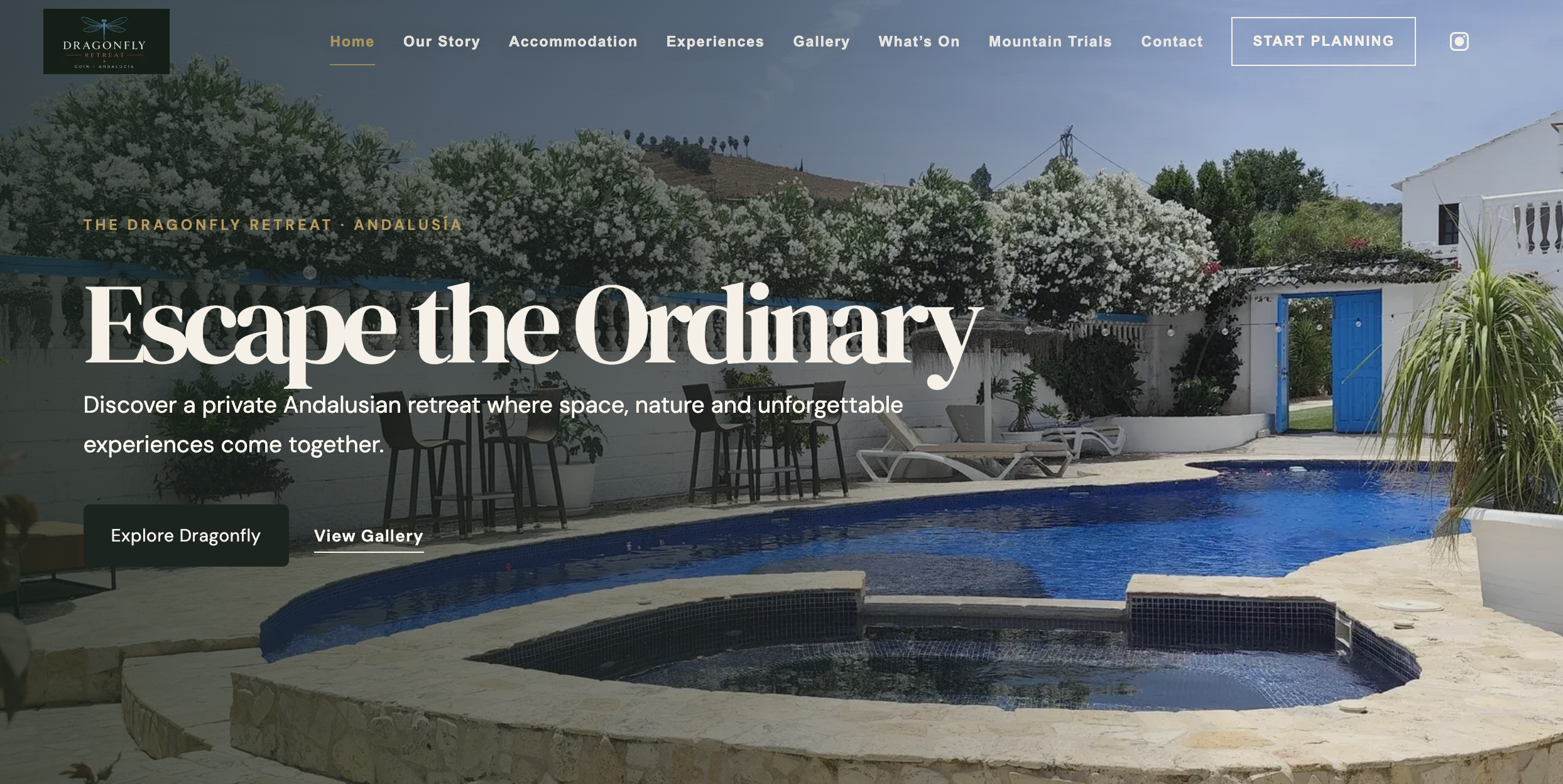
If you are weighing up a private stay for your group, see the rooms and suites and have a look at life at Dragonfly to get a feel for the place.
FAQ
Is it better to book one private property or several hotel rooms?
For groups who want to spend time together, one private property usually works better. You share meals and evenings without arranging meeting points, and you have one contact for everything. Hotel rooms can suit groups who want separate schedules and more independence.
How far ahead should I book group accommodation near Málaga?
Book as soon as your dates and numbers are firm, particularly for July and August, which are the busiest and most expensive months in the area. Shoulder months can be easier to arrange, but the best private properties still book up, so ask the owner about availability directly.
What should I ask about exclusive use?
Ask whether your group will be the only guests for the whole stay, who else may be on site (staff, caterers, tutors), and whether any part of the property is off limits. Get the answer in writing, along with the cancellation and damage terms.
Do we need a car if we stay in the countryside?
Usually it helps, for shopping, restaurants and day trips, unless the venue arranges transfers and hosted meals. Agree who will drive, make sure hire cars are properly insured, and follow the UK government’s advice on keeping valuables out of sight.
Can a private venue host a retreat or celebration as well as a holiday?
Yes, many do, but check the layout, noise rules and any extra costs first. Ask whether there is space for your activity, your whole group at one table, and a plan for wet weather.
Sources
- Residential Visits guidance
- Conference Venue Checklist: 26 Things to Confirm
- Choosing a venue, University of Oxford Communications Hub
- Venue Capacity for Offsites: Sleep, Meet and Dine Numbers
- Spain travel advice, GOV.UK
- Holidaymakers warned to watch out for highway robbers in Spain
- Travel to Spain for work, GOV.UK
- Decreto 28/2016 on tourist-use dwellings (consolidated text)
- Decreto 28/2016, BOJA