
DRAGONFLY JOURNAL
Offsite Agenda Template: Two- and Three-Day Plans for Teams
Offsite Agenda Template: Two- and Three-Day Plans for Teams

A good offsite agenda has two or three outcomes, work blocks of no more than 90 minutes, real gaps between them, an evening with no presentations and a closing session that ends with named owners and dates. Below you will find a copy-and-adapt template for a two-day and a three-day company offsite, plus the reasoning behind each block, so you can change the timings without losing the shape.
We host groups at The Dragonfly Retreat, a private countryside venue near Coín, in the hills inland from Málaga, so the examples lean towards a residential stay in southern Spain. The structure works just as well at any venue with a good meeting room and somewhere to walk.
TL;DR
- Choose two or three outcomes first, then build the agenda around them. Anything that does not serve an outcome comes out.
- Keep work blocks to 90 minutes or less, put heavy thinking in the morning and interactive work after lunch.
- Plan roughly 70% of the time with content and leave the rest free for breaks, discussion and overruns.
- Finish with decisions read back, one owner and one deadline per action, and follow-up dates booked before anyone leaves.
- Send the final agenda to attendees about a week ahead, with any pre-reading kept short.
Table of Contents
- Start with outcomes, not with timings
- What every offsite agenda should include
- Two-day offsite agenda template
- Three-day offsite agenda template
- How to balance productive meetings with informal time
- Ground rules and facilitation
- Why the venue shapes the agenda
- The closing session: turn the offsite into action
- Adapting the template
- Plan your offsite near Málaga
- FAQ
- Sources
Start with outcomes, not with timings
Most agendas fail before the first session, because the team has filled the calendar before deciding what the offsite is for. A useful starting point is to define the purpose and the tangible outputs, then name the intangible outcomes, such as trust or alignment, and design the key working sessions around them, as SessionLab’s offsite guide suggests.
Write each outcome as something you will have when you leave: “a ranked list of next year’s three priorities”, “an agreed way of handing work between sales and delivery”. Three to five short objectives at the top of the agenda give everyone a reference point during the day, and the Eblin Group also advises limiting each day to two or three major topics and going deep rather than working through a long list.
If you cannot fit your wish list into that, you have two offsites’ worth of material. Split it, or move some of it back into ordinary team meetings.
What every offsite agenda should include
For the people attending, the agenda needs to be simple. For you, as organiser, it needs more detail. MindTools advises that each item shows its nature, the outcome required, the time allowed and who is introducing it. Vantly’s working template goes further for offsites, adding room or space, AV and materials, food and drink notes and a backup plan, and it keeps those columns in an internal version while sharing a cleaner copy with attendees.
Here is a working layout you can copy into a spreadsheet:
| Time | Block | Purpose / outcome | Owner | Space | Kit and materials | Food and venue notes | Backup plan |
|---|---|---|---|---|---|---|---|
| 10:00 | Welcome | Agree goals and ground rules | Sponsor | Main meeting room | Screen, flip charts | Coffee out from 09:30 | Move outside if the room is warm |
The last two columns are the ones people leave out and then regret. A session planned for the terrace needs an indoor alternative, and a workshop that needs a printer needs someone who knows where the printer is. If you are comparing venues, these business travel hotel details are worth confirming before you book, as they feed straight into the room and equipment columns.
Assign roles as well as topics. Sessionplan recommends separate moderator, documentation and timekeeping roles instead of leaving the chief executive to moderate by default. It frees the most senior person to take part as a contributor.
Two-day offsite agenda template
Two days suits a team of roughly 8 to 20 that needs one significant decision set and some time to reconnect. Day one is for opening up the problem, day two is for narrowing it and committing. This pattern follows the usual shape of a residential offsite: arrival, welcome, workshop, lunch, activity, break, debrief and dinner on the first day, then review, action planning, lunch, a light session and commitments on the second.
Day one: open the topic
| Time | Block | Notes |
|---|---|---|
| 09:30 | Arrival and coffee | Leave the first half hour unstructured. People who have travelled need to land. |
| 10:00 | Welcome and framing | State the outcomes, agree ground rules, explain how decisions will be recorded. |
| 10:30 | Work block 1: the big question | Analytical or strategic content while energy is highest. 90 minutes at most. |
| 12:00 | Break | A real break, away from the meeting room. |
| 12:30 | Lunch | Allow a full hour. Seat people with colleagues from other teams. |
| 13:30 | Work block 2: small groups | Interactive format, with groups of three or four working on one part of the question each. |
| 15:00 | Break and free time | Walk, swim, check email. Phones are for breaks, not for sessions. |
| 15:30 | Group activity | Something that has nothing to do with the agenda. |
| 17:00 | Debrief | Twenty minutes: what did we learn, what is still open? |
| 17:30 | Free time | Rest before dinner. |
| 19:30 | Dinner | No presentations, no seating plan. |
Day two: narrow and commit
| Time | Block | Notes |
|---|---|---|
| 08:30 | Breakfast | Unhurried. |
| 09:30 | Review of day one | Fifteen minutes, then move on to the sticking points. |
| 09:45 | Work block 3: decide | Convergent work: rank, choose, agree. 90 minutes. |
| 11:15 | Break | Thirty minutes. |
| 11:45 | Action planning | Turn each decision into an action, with one owner and one date. |
| 13:00 | Lunch | Full hour. |
| 14:00 | Commitments and closing | Read back the decisions, confirm owners, book the follow-ups, and finish on time. |
| 15:00 | Departure |
Notice that day two has less content than day one. The team is tired, and the work is harder because it is about choosing. Resist the urge to add a second workshop.
Three-day offsite agenda template
Three days gives you room for something two days cannot: a proper pause between thinking widely and deciding. It suits leadership teams working on strategy, or teams that are newly formed or have recently merged. Day one is for arrival and opening, day two for the deep work, day three for decisions and departure.
| Day | Morning | Afternoon | Evening |
|---|---|---|---|
| 1 | Travel and arrival. Light lunch on arrival. | 15:00 welcome and framing, then a 60-minute session to set goals and ground rules. | Dinner together and an easy social activity. Nothing to prepare. |
| 2 | Two work blocks of 90 minutes each, with a 30-minute break between them. Analytical and strategic topics. | After a full lunch hour, interactive group work, then a long break of at least an hour. Late afternoon debrief. | A longer, informal evening. Cooking together, a tasting or a walk suits better than a presentation. |
| 3 | One 90-minute decision block, a break, then action planning. | Closing session with decisions read back, owners and dates agreed, and departure. | Travel home. |
The long break on day two matters. A facilitation approach that separates idea generation from decision-making relies on a substantial pause between the two so people can shift mindset. Putting that pause overnight, as this layout does, costs you nothing.
How to balance productive meetings with informal time
The schedule feels overpacked when every gap has been given a purpose. These habits keep it human.
Plan about 70% of the time. Sessionplan suggests planning no more than 70% of the retreat with content, leaving the remainder for discussion, breaks and unforeseen deep dives. In practice, a session that runs over then eats the buffer, not your dinner.

Cap work blocks at 90 minutes. Follow each with a genuine break of at least 15 to 30 minutes. The most common mistake is a “break” that is really a working lunch with a slide deck.
Put the thinking in the morning. Analytical and strategic topics go before lunch, interactive formats and group work after, and the evening is for informal conversation without presentations, again per Sessionplan’s guidance.
Give people free time after the first intensive day. The UK guidance from Perk recommends free time after an intensive first day, followed by dinner and an inclusive social activity that is not centred on alcohol. That is sound advice for a mixed team, where not everyone drinks and not everyone wants a late night.
Make the social part optional and good. A team activity should be easy to join and easy to step out of. Cooking, painting, a guided walk or a wine tasting work because they give people something to do with their hands while they talk. For ideas, see our guide to corporate retreat team-building activities that work.

Keep the pre-work light. If you set reading, the Eblin Group recommends no more than two hours in total, linked to specific agenda topics. Say which session each document is for.
Ground rules and facilitation
Spend the first ten minutes agreeing how the group will work. Sensible ground rules include phones and laptops closed except in working sessions, disagreeing in the room and committing outside it, logging decisions on the wall as they happen, and putting parked topics on a list with an owner. Offsiteio’s strategic planning template lists these as examples.
It also helps to remember that, in UK workplaces, agenda-setting is often seen as a privilege of the senior person, though the CIPD’s evidence review on productive meetings notes that the list is not set in stone and input from others is encouraged. Ask the team for topics a few weeks before. You will get a better agenda, and people will arrive with a sense that the offsite is theirs.
The same CIPD summary recommends starting and ending on time and recapping the goals throughout. Put a one-line reminder of the outcomes on the wall of the meeting room, and have your timekeeper use it.
Why the venue shapes the agenda
An agenda is only as good as the space it runs in. A residential, private venue lets you do things a hotel conference room cannot: start the day outside, hold a small-group session on a terrace, and let the evening drift from dinner into conversation without anyone needing to find a taxi.
The Dragonfly Retreat is a private countryside venue near Coín, with private bedrooms, indoor and outdoor communal spaces, terraces, gardens and a swimming pool. It is not a conventional hotel or resort, and a group can have the place to themselves. For a team, that means the work blocks, meals and downtime all happen in the same place, which makes the 70% rule easy to keep: there is no travel time to build into the day. If you are weighing up where to hold it, our guide on how to choose a group retreat venue in Málaga covers the questions to ask, and why exclusive retreats beat apartments for group stays explains the case for staying under one roof.
For evening social time, we offer Mediterranean food, paella evenings and wine tasting, and our cooking team-building ideas are set out in this guide to cooking activities for corporate retreats in Andalucía. They sit neatly in the first-evening slot of the templates above, when you want people talking but not working.
The closing session: turn the offsite into action
The closing is where most offsites quietly lose their value. A good one is not a round of thanks. It follows a set order:
- Read back every decision aloud, so that the group confirms what was agreed.
- Give each action one owner and one deadline. Granola’s guidance is to do this before participants disperse, and to book follow-up checkpoints before leaving the venue.
- Record actions in one shared place, ideally the tool the team already uses for its work.
- Send a written summary within 24 hours, with a one-week sync and a one-month review, as Granola recommends.
- Review the outcomes at the next regular team meeting, so they do not fade.
The CIPD’s practice summary says the same thing in plainer terms: after a meeting, follow up by sharing minutes, action points, and roles and responsibilities for achieving the outcomes.
Leave at least 45 minutes for this. It is the one block that should never be squeezed to protect the schedule.
Adapting the template
For a single day, keep one outcome, two work blocks and one activity. Open at 09:30 with coffee, work until lunch, run an activity or workshop in the afternoon, and close at around 16:00 with owners and dates.
For a larger group, add breakout rooms and a second facilitator, and keep the plenary blocks short. Check that your venue has enough separate spaces before you commit to a format.
For a creative or cultural team, swap the afternoon group session for something hands-on. Our retreat planning checklist takes you from first idea to final day if you want the logistics alongside the agenda.
Share the right version. Attendees need the clean copy: times, titles, locations, what to bring. Keep the owner, kit, food and backup columns for yourself and the facilitators.
Plan your offsite near Málaga
If you would like to hold your offsite in southern Spain, we can build the stay around your agenda: accommodation for the whole group, meal planning, and activities to fill the social slots. Quotes are based on your group size, dates and the activities you choose. Our Plan Your Own Group Experience page is the best place to start, and our food and wine experiences, Cooking, Food, Wine & Mediterranean Living, start from €1,095 per person.
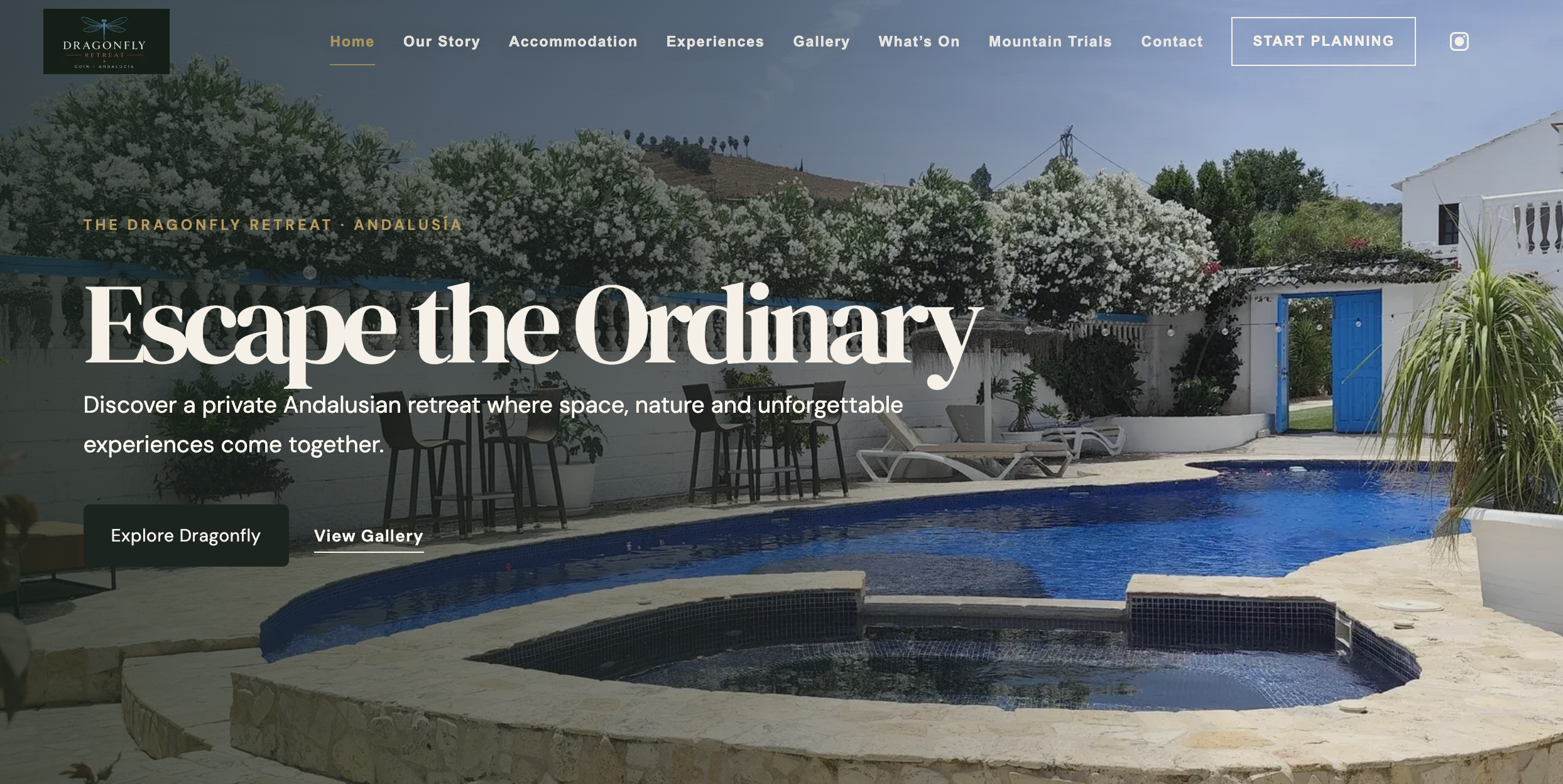
You can see the rooms, including the Pearl Suite, Wisdom Room, Starburst Cottage and Starlight Rooms, on our accommodation page, or look at the wider group stays at The Dragonfly Retreat. When you are ready, we would be glad to talk through corporate retreats with you.
FAQ
How long should an offsite agenda be?
One day suits a single focused topic, two days suits a team that needs a set of decisions, and three days suits strategy work or a newly formed team. More time is only useful if the agenda has room to breathe. Limit each day to two or three major topics.
How far ahead should we send the agenda?
About a week before is a good rule for an offsite, which gives people time to familiarise themselves with the plan and prepare. Send any pre-reading with it, kept short and labelled by session.
What should we do on the evening of day one?
After an intensive first day, give people free time, then a shared dinner and an easy social activity that is not built around alcohol. Cooking together, a tasting or a walk all work. Keep presentations and work discussion out of it.
How do we stop an offsite feeling overpacked?
Plan roughly 70% of the time, cap work blocks at 90 minutes and protect the breaks. Choose two or three outcomes and drop everything else. If a session overruns, take the time from the next work block, not from lunch or the evening.
Sources
- Productive meetings: An evidence review, practice summary (CIPD, May 2023)
- How to plan a team offsite: a complete guide (SessionLab)
- How to Develop a Great Strategic Leadership Offsite Agenda (Eblin Group)
- How to Lead an Effective Meeting (MindTools)
- Offsite Agenda Template: 1-, 2- and 3-Day Plans (Vantly)
- Management Offsite Agenda: 2-Day Template and Guide (Sessionplan)
- Team Offsite Agenda Template and Guidelines (Perk UK)
- How to plan a team offsite (Granola)
- How to Plan an Offsite Meeting Agenda (Throughline)
- Strategic Planning Retreat Agenda Template (Offsiteio)
- How to Plan a Team Offsite: The 6-Part Strategy Agenda (Dave Bailey)
- Confirm These 3 Hotel Details Before Booking for Business Travel